
RuTAG Initiative
- 17 Nov 2025
In News:
The Rural Technology Action Group (RuTAG)is an initiative launched in 2004 by the Office of the Principal Scientific Adviser (OPSA) to the Government of India. It was conceptualised as a mechanism to bring science and technology interventions to rural areas by focusing on demand-driven solutions.
RuTAG functions as a bridge between research institutions and grassroots communities, aiming to upgrade existing rural technologies, fill technology gaps, and support training, demonstrations and field adoption. Its approach emphasises stakeholder collaboration-engaging NGOs, self-help groups, community organisations and rural start-ups to identify local challenges and design technology interventions suited to socio-economic and regional priorities.
RuTAG’s major objectives include:
- Identifying rural technology needs through engagement with community-based organisations and field partners.
- Developing demand-driven technologies based on socio-economic data aligned with national and regional development priorities.
- Validating prototypes and exploring scalability and field deployment.
- Commercialising viable technologies for national and global markets to ensure wider dissemination.
In April 2023, the OPSA launched RuTAG 2.0, marking a shift from prototype development to commercialisation and large-scale dissemination of technologies. RuTAG 2.0 places greater emphasis on converting innovations into market-ready products, ensuring broader accessibility and measurable socio-economic impact in rural India. The initiative aims to strengthen rural value chains, support micro-enterprises, and promote sustainable livelihoods through technology-enabled solutions.
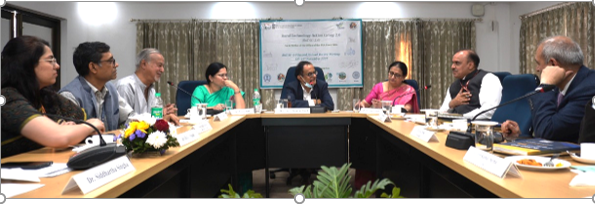
Recently, the Principal Scientific Adviser, Prof. Ajay Kumar Sood, chaired the second annual review meeting of RuTAG 2.0 at IIT Guwahati. The meeting reviewed progress made across all seven RuTAGCentres—IIT Guwahati, IIT Delhi, IIT Bombay, IIT Roorkee, IIT Madras, SKUAST-Kashmir and ICAR-NAARM Hyderabad. Discussions focused on scaling validated technologies, strengthening inter-centre collaboration and deepening partnerships with state governments, industries and community organisations. The review highlighted significant achievements, including expanding collaborations with state departments, demonstration of drone-based rural applications, and increased field-level adoption of technologies.
The PSA released the RuTAG 2.0 Annual Progress Report 2024–25, documenting 56+ ongoing projects addressing rural challenges in agriculture, animal husbandry, post-harvest management, renewable energy, water purification and rural crafts. Many of these projects have reached prototype validation and field deployment stages. The event also saw the inauguration of the Centre for Innovation in Agri & Aqua Voltaics (CIAAV) and the Integrated Facility for Wellness-Product Innovation (IFWPI) at IIT Guwahati, intended to promote interdisciplinary research and rural entrepreneurship in the North-East region.
A Grassroots Innovation and Startup Exhibition showcased prototypes and rural technologies developed under RuTAG 2.0, while drone-based applications were demonstrated at the School of Agro and Rural Technology (SART), IIT Guwahati. A multi-stakeholder meeting involving representatives from MDoNER, MSME Ministry, NECTAR, ASTEC, NABARD, ASRLM, and state governments focused on strategies for scaling technologies and integrating them into rural livelihood programmes.
The two-day review concluded with a strategic roadmap emphasising:
- Commercialisation of proven technologies
- Stronger industry–academia–community partnerships
- Standardisation and quality control across RuTAGCentres
- Measurable socio-economic impact through technology deployment
RuTAG 2.0 reinforces the role of science and technology in empowering rural communities and building self-reliance by ensuring that innovations developed in research institutions translate into meaningful, scalable solutions for rural India.