
Renaming of Kerala as “Keralam”
- 26 Feb 2026
In News:
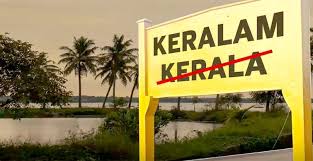
The Union Cabinet has approved a proposal to rename the State of Kerala as “Keralam.” The move reflects linguistic and cultural identity considerations and now requires Parliamentary approval under the constitutional procedure governing alteration of state names.
Historical Evolution of the State of Kerala
Pre-Independence Background
Before Independence, Malayalam-speaking regions were politically fragmented across:
- Malabar District (under British Madras Presidency)
- Princely States of:
- Travancore
- Cochin (Kochi)
In the 1920s, the Aikya (Unified) Kerala Movement emerged, demanding a single state for Malayalam-speaking people based on linguistic identity.
Post-Independence Developments
- 1 July 1949: Travancore and Cochin merged to form the Travancore–Cochin State.
- The Government of India appointed the State Reorganisation Commission (SRC) under Justice Fazl Ali.
- The SRC recommended the creation of linguistic states, including a unified Kerala.
Formation of Kerala
- 1 November 1956: Kerala was formally created under the States Reorganisation Act, 1956.
- It comprised:
- Malabar District (from Madras State)
- Travancore–Cochin State (excluding certain Tamil-majority areas)
Thus, Kerala emerged as a linguistic state representing Malayalam-speaking populations.
Constitutional Procedure to Rename a State
The renaming of a state is governed by Article 3 and Article 4 of the Constitution of India.
Article 3: Powers of Parliament
Parliament may by law:
- Form a new state
- Increase or diminish the area of any state
- Alter state boundaries
- Alter the name of any state
However, two procedural safeguards apply:
- A Bill for such change can be introduced in Parliament only with prior recommendation of the President.
- Before recommending the Bill, the President must refer it to the concerned State Legislature to express its views within a specified period.
Importantly:
- The President (and Parliament) is not bound by the views of the State Legislature.
- Parliament may accept or reject the state’s suggestions.
Article 4: Nature of the Law
- Laws made under Article 3 are not considered Constitutional Amendments under Article 368.
- Such laws:
- Can be passed by simple majority
- Follow the ordinary legislative procedure
Thus, renaming a state does not require a special majority or ratification by states.
Federal and Political Context
The renaming of states often reflects:
- Linguistic identity
- Cultural assertion
- Historical reclamation
- Regional aspirations
For instance, past examples include:
- Orissa → Odisha
- Pondicherry → Puducherry
- Uttaranchal → Uttarakhand
However, not all renaming proposals have been successfully implemented, highlighting the political and procedural complexities involved.
Significance of the “Keralam” Proposal
- Linguistic Authenticity: “Keralam” is the Malayalam name for the state.
- Cultural Identity: Reinforces regional linguistic heritage.
- Federal Procedure in Action: Demonstrates constitutional flexibility under Article 3.
- Non-Amendment Process: Highlights distinction between ordinary legislation and constitutional amendment.