
RAMP Programme
- 27 Feb 2026
In News:
The Ministry of Micro, Small and Medium Enterprises (MoMSME) recently convened the 5th meeting of the National MSME Council in New Delhi to review the progress of the World Bank–assisted Raising and Accelerating MSME Performance (RAMP) Programme. The review gains significance in the context of MSMEs being the backbone of India’s economy and central to achieving inclusive growth, Atmanirbhar Bharat, and the $5 trillion economy vision.
About the RAMP Programme
- It was launched in 2022 and is being implemented over a five-year period (2022–23 to 2026–27) by the Ministry of MSME with World Bank support.
- It seeks to address structural challenges faced by MSMEs through systemic reforms and capacity building at both the Central and State levels.
Objectives of RAMP
The programme focuses on:
- Improving Access to Market and Credit
- Enhancing financial inclusion.
- Promoting integration into domestic and global value chains.
- Strengthening Institutions and Governance
- Capacity building of MSME institutions at Central and State levels.
- Improving policy design and implementation mechanisms.
- Enhancing Centre–State Coordination
- Encouraging cooperative federalism through structured partnerships.
- Providing financial assistance to States for preparing Strategic Investment Plans (SIPs).
- Addressing Delayed Payments: Tackling liquidity stress among Micro and Small Enterprises (MSEs).
- Greening of MSMEs: Supporting climate-resilient and sustainable business practices in alignment with India’s Net Zero target of 2070.
Institutional Framework
National MSME Council
- Established by MoMSME as the administrative and functional body under RAMP.
- Provides strategic direction, monitors progress, and facilitates coordination among stakeholders.
State-Level Role
- States receive grants to prepare Strategic Investment Plans (SIPs).
- SIPs align state-specific reforms with national MSME objectives.
- Promotes decentralised planning and context-specific solutions.
Key Sub-Schemes under RAMP
1. MSME GIFT Scheme
(MSME Green Investment and Financing for Transformation)
- Promotes adoption of green technologies.
- Provides interest subvention and credit guarantee support.
- Encourages energy efficiency, cleaner production, and sustainability.
2. MSE SPICE Scheme
(Scheme for Promotion and Investment in Circular Economy)
- Supports circular economy initiatives among MSEs.
- Offers credit-linked capital subsidy.
- Contributes toward the long-term objective of MSMEs achieving net-zero emissions by 2070.
3. MSE ODR Scheme
(Online Dispute Resolution for Delayed Payments)
- First-of-its-kind initiative integrating legal support with IT tools and Artificial Intelligence.
- Addresses the chronic issue of delayed payments to Micro and Small Enterprises.
- Strengthens ease of doing business and improves working capital cycles.
Significance for the Indian Economy
- MSMEs contribute significantly to GDP, exports, and employment generation.
- RAMP supports:
- Formalisation and competitiveness.
- Digital transformation.
- Climate-aligned industrial growth.
- Improved credit flow and risk mitigation.
- It operationalises cooperative and competitive federalism through structured Centre–State collaboration.
MSME Ministry launches 3 sub-schemes under RAMP programme; makes ZED scheme free for women (Financial Express)
- 21 Dec 2023
Why is it in the News?
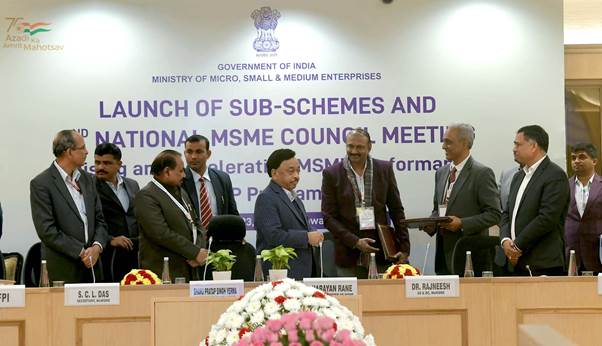
MSME Minister Narayan Rane recently launched three sub-schemes under the ministry’s existing RAMP ((Raising and Accelerating MSME Productivity) programme.
About the RAMP Programme:
- The Raising & Accelerating MSME Performance (RAMP) program, supported by the World Bank and inaugurated in 2022, is dedicated to enhancing the performance of micro, small, and medium enterprises (MSMEs) across India.
Program Objectives:
- Market and Credit Access: Facilitate improved access to markets and credit for MSMEs.
- Institutional Strengthening: Enhance institutional and governance structures at both central and state levels.
- Center-State Collaborations: Foster improved linkages and partnerships between central and state entities.
- Delayed Payment Issues: Address challenges related to delayed payments within the MSME sector.
- Greening of MSMEs: Promote sustainable practices and the adoption of green technologies within MSMEs.
- The National MSME Council has been set up by the Ministry to work as an administrative and functional body of the RAMP Programme.
Sub Schemes under RAMP:
- MSME GIFT Scheme: Aims to support MSMEs in adopting green technology through interest subvention and credit guarantee assistance.
- MSE SPICE Scheme: Focuses on promoting circular economy projects, with credit subsidy mechanisms, aligning with the MSME sector's goal of achieving zero emissions by 2070.
- MSE ODR Scheme: A pioneering initiative leveraging modern IT tools and Artificial Intelligence to address delayed payment incidents for Micro and Small Enterprises.
- Implementing Agencies for Sub Schemes:
- MSME GIFT and MSME SPICE Schemes: Small Industries Development Bank of India (SIDBI)
- MSE ODR Scheme: National Informatics Centre Services Inc. (NICSI)
- These sub-schemes, under the RAMP umbrella, signify a comprehensive effort to fortify and propel the growth of MSMEs, incorporating technological advancements and sustainable practices.