
Methylocucumisoryzae
- 12 Nov 2025
In News:
India has identified a home-grown biological solution to methane mitigation, a major contributor to climate change, through the discovery of indigenous methanotrophic bacteria from rice fields and wetlands, particularly in western India. This discovery strengthens India’s climate response by leveraging natural microbial processes rather than energy-intensive technological interventions.
Methane and Climate Change
- Methane (CH?) is a colourless, odourless, flammable gas, also called marsh gas.
- It is the second most important greenhouse gas after carbon dioxide.
- Methane has ~26 times higher global warming potential than CO? over a 100-year period.
- Major sources include wetlands, rice paddies, ruminant livestock, and landfills, where methane is produced by methanogens under anaerobic conditions.
Methanotrophs: Natural Methane Mitigators
- Methanotrophs are methane-oxidising bacteria that consume methane as their energy source.
- They oxidise methane into CO? and water, while building their own biomass.
- Habitat: Wetlands, rice fields, ponds, quarry waters, and other oxygen–methane interface zones.
- Their ecological role is critical in preventing a sharp rise in atmospheric methane concentrations.
Discovery of Methylocucumisoryzae
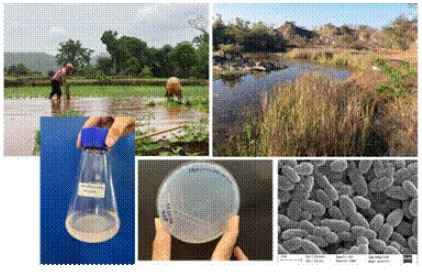
Scientists at MACS Agharkar Research Institute, an autonomous institute under the Department of Science and Technology (DST), have isolated and characterisedIndia’s first indigenous methanotroph cultures.
- A novel genus and species named Methylocucumisoryzae was described.
- The bacterium has an oval, elongated, cucumber-like shape, earning it the nickname “methane-eating cucumber”.
- It remains phylogenetically unique and endemic, with no reports from outside India even after a decade of study.
Key Features of Methylocucumisoryzae
- Habitat: Rice fields, wetlands, and water-filled stone quarries (e.g., VetalTekdi–ARAI hill, Pune).
- Size: Unusually large for bacteria (3–6 µm), comparable to small yeast cells.
- Thermal behaviour: Strictly mesophilic; cannot grow above 37°C, unlike many methanotrophs.
- Colony colour: Light pale pink, linked to a carotenoid biosynthesis pathway.
- Ecological role: Indicates an active methane cycle in natural and semi-natural ecosystems.
Agricultural and Biotechnological Significance
- Experimental studies show that Methylocucumisoryzae can promote rice plant growth, inducing:
- Early flowering
- Increased grain yield
- Trials were conducted on the Indrayani rice variety, widely cultivated in Maharashtra.
- This highlights a dual benefit: climate mitigation and agricultural productivity.
Constraints and Way Forward
- A major limitation is the slow growth rate, restricting large-scale cultivation for direct application.
- However, its natural abundance in rice fields and wetlands suggests it already plays a silent but significant role in methane mitigation.
- Improving culture techniques could enable future use in climate-smart agriculture and biotechnological applications.