
Foraminifera
- 19 Nov 2025
In News:
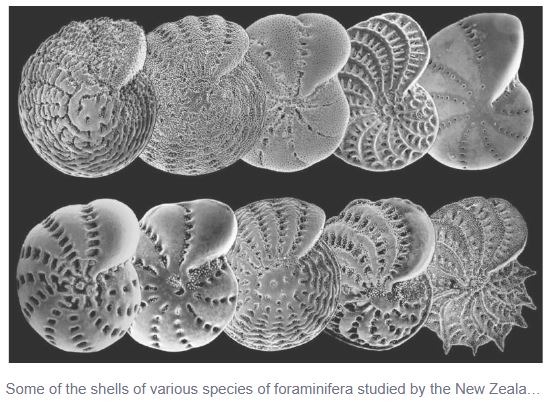
A recent global scientific review has identified 57 new living species of foraminifera, including newly recorded species from New Zealand waters. This research, published in Micropaleontology, used advanced DNA sequencing and morphological analysis to classify living species found in coastal and shallow seafloor sediments worldwide.
What are Foraminifera?
- Foraminifera (forams) are single-celled marine organisms found in:Open oceans, Coastal waters, and Estuaries
- They possess protective shells (tests) and exist as:Planktonic (free-floating), and Benthic (living on the sea floor)
Population Structure
- About 8,000–9,000 living species are known globally.
- Only ~40 species are planktonic; the majority are benthic.
- They generally measure less than 500 microns, though some tropical species can reach 20 cm.
Meaning of the Name
- “Foraminifera” comes from the presence of many tiny shell openings called foramina (“windows” in Latin).
- They extend pseudopodia (false feet) through these holes to move and capture food.
Feeding Habits
- Diet includes:Detritus on the sea floor, Diatoms, Algae, Bacteria, Tiny animals such as copepods
Shell Structure
- Forams build shells made of:
- Calcium carbonate (calcareous)or
- Aggregated sand grains (agglutinated)
- Shells range from single-chambered forms to complex multi-chambered coiling structures, despite their simple cellular structure.
Ecological and Scientific Importance
Foraminifera have existed for millions of years, making them valuable for:
- Paleoclimate reconstruction
- Sea-level change studies
- Pollution and sediment runoff assessment
- Understanding coastal earthquake and tsunami history
- Tracking marine ecosystem shifts
They are widely used in geology, paleoenvironmental studies, and environmental monitoring due to the long-term preservation of their shells in sediments.
Key Findings from the Latest Global Review
Diversity Distribution
- Highest diversity found in the Northwest Pacific (China–Japan coasts): 74 species
- Followed by Australia: 58 species
- No species recorded from Antarctica
- 24 species identified around the Arctic Ocean
New Zealand Findings
- Three new species were documented from:
- Stewart Island
- Tolaga Bay
- Waitemata Harbour
- These specimens are now stored in NZ museum collections.
Human-Driven Species Transport
- At least 33 non-native species were found far from their natural evolutionary origins.
- Likely transported across oceans unintentionally via:
- Ballast water from ships
- Sediment movement
This highlights the role of human activity in altering marine biodiversity patterns.