
Vanadium Redox Flow Battery (VRFB)
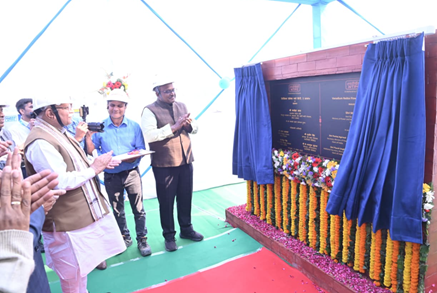
- 14 Nov 2025
In News:
India has taken a significant step in long-duration energy storage with the inauguration of the country’s first megawatt-hour (MWh) scale Vanadium Redox Flow Battery (VRFB) at NTPC’s NETRA facility in Noida. The project was inaugurated by the Union Minister for Power, highlighting India’s growing focus on grid resilience, renewable energy integration, and clean energy technologies.
What is Vanadium?
- Vanadium (V) is a chemical element with atomic number 23.
- It is a silver-grey, ductile, and malleable metal.
- Exhibits high strength, corrosion resistance, and stability against alkalis and acids.
Occurrence and Distribution
- Vanadium is the 22nd most abundant element in Earth’s crust.
- Occurs combined in over 60 minerals, including:
- Vanadinite
- Carnotite
- Roscoelite
- Patronite
- Also found in coal and petroleum deposits.
- Major reserves: South Africa and Russia.
- Leading producers: China, Russia, and South Africa.
Applications of Vanadium
- Metallurgy:Used as an alloying element in steel to improve strength, durability, and resistance to wear.
- Energy Storage:Core material in Vanadium Redox Flow Batteries (VFBs/VRFBs) for large-scale and long-duration energy storage.
- Chemical Industry:Vanadium compounds act as catalysts, notably in sulphuric acid production.
- Nuclear Sector:Used in certain reactors as structural material and neutron moderator.
- Medical Research:Studied for potential roles in managing diabetes, cardiovascular diseases, and cholesterol (experimental/therapeutic research).
What are Vanadium Redox Flow Batteries (VRFBs)?
- VRFBs are electrochemical energy storage systems where energy is stored in liquid vanadium electrolytes held in external tanks.
- Both the positive and negative electrolytes use different oxidation states of vanadium, reducing cross-contamination risks.
Advantages of VRFBs
- Long-duration storage: Suitable for grid-scale applications (hours to days).
- High safety: Non-flammable electrolytes reduce fire risk.
- Long life cycle: Can endure tens of thousands of charge–discharge cycles.
- Scalability: Energy capacity can be increased by enlarging electrolyte tanks.
- Grid stability: Ideal for balancing intermittent renewable sources like solar and wind.
India’s First MWh-scale VRFB at NTPC NETRA
- Installed at NETRA (National Energy Technology Research Alliance), Noida, a premier R&D centre of NTPC.
- Capacity: 3 MWh.
- Significance:
- Demonstrates India’s capability in advanced energy storage technologies.
- Supports renewable energy integration and grid reliability.
- Aligns with national goals on energy transition and energy security.