
Sakurajima Volcano
- 20 Nov 2025
In News:
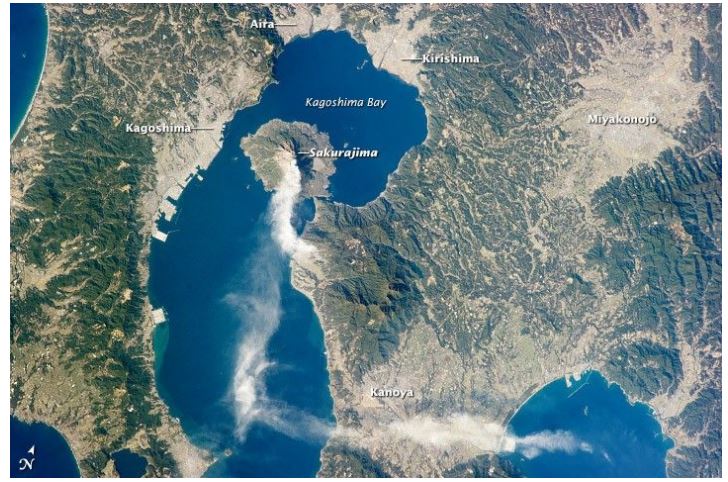
Sakurajima, one of the most active volcanoes of Japan, erupted multiple times recently, sending ash and smoke plumes up to 4.4 km into the atmosphere. The eruption led to ashfall-related disruptions, including cancellation of flights at Kagoshima Airport. This was the first eruption in nearly 13 months to send ash above 4 km.
Location & Geological Setting
- Located on the southern tip of Kyushu, near Kagoshima
- Lies at the southern edge of the Aira Caldera
- Situated on a convergent plate margin, associated with subduction-related volcanism
Type & Structure
- Stratovolcano: Built from alternating layers of lava and ash
- Andesitic volcano:
- Magma is highly viscous
- High gas content, making eruptions potentially explosive
- Composed mainly of two central cones:
- Kitadake (north peak)
- Minamidake (south peak)
Eruptive History
- Among the most active volcanoes in Japan, with frequent eruptions of varying intensity
- 1914 eruption:
- One of Japan’s most powerful eruptions
- Lava flows filled the strait, connecting Sakurajima island to the mainland peninsula
- 2019 eruption: Ash plume rose up to 5.5 km
- Recent eruptions monitored by the Japan Meteorological Agency, which also warned of ashfall in Kagoshima and nearby Miyazaki region
Associated Impacts
- Ashfall affecting aviation, transport and daily life
- Recurrent eruptions make Sakurajima a key site for volcanic hazard monitoring and disaster preparedness
What is a Volcano?
- A volcano is an opening in the Earth’s crust through which magma, gases and ash escape
- Eruptions may be:
- Explosive (ash columns, pyroclasts)
- Effusive (lava flows)
- Duration can range from days to years
Sakurajima Volcano Eruption
- 17 May 2025
In News:
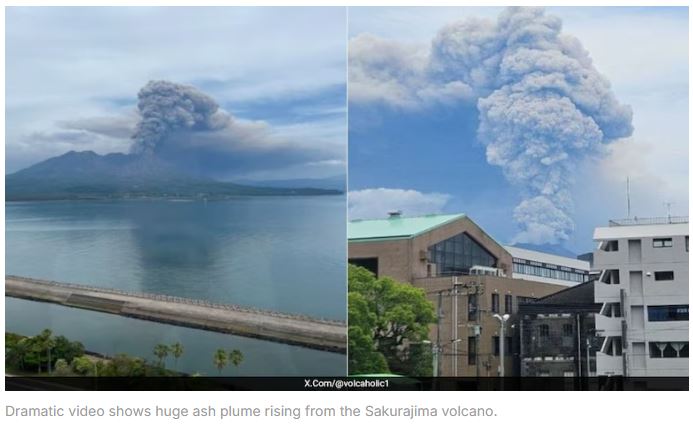
Japan’s Sakurajima volcano, located in Kagoshima Prefecture on the southern island of Kyushu, recently erupted sending a dense ash plume 3,000 metres into the sky. The eruption originated from the Minamidake summit crater and was accompanied by a Level 3 volcanic alert, advising people to stay away from the vicinity.
Key Features of Sakurajima Volcano:
- Type: Stratovolcano (composite volcano)
- Geological Setting: Situated on a convergent plate boundary, formed from subduction-related volcanic activity.
- Structure: Comprises North Peak and South Peak, and lies on the southwestern rim of the Aira Caldera.
- Historical Significance: Was an island until the 1914 eruption, which connected it to the ?sumi Peninsula.
- Frequent Activity: One of Japan's most active volcanoes, experiencing daily minor eruptions and emitting continuous volcanic smoke.
Volcanic Characteristics:
- Lava Type:Andesitic – high in gas content and viscosity, leading to explosive eruptions.
- Hazards: Produces ash fall, pyroclastic flows, volcanic bombs, and toxic gases.
- Proximity to Populated Areas: Only 4 km from Kagoshima City, making it a high-risk volcano with strict monitoring by the Japan Meteorological Agency (JMA).
Impact and Preparedness:
- No injuries or major damages have been reported as of now.
- Ash fall warnings were issued for Kagoshima, Kumamoto, and Miyazaki prefectures.
- The eruption highlights Japan’s robust disaster preparedness and early warning systems, essential due to the country's location on the Pacific Ring of Fire.