
Nyoma Air Base Operationalised in Eastern Ladakh
- 15 Nov 2025
In News:
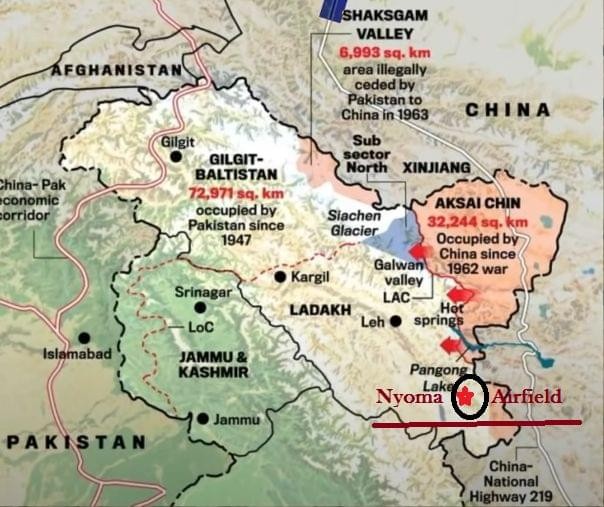
The Indian Air Force (IAF) has formally operationalised the Nyoma Air Base in Eastern Ladakh after Air Chief Marshal A.P. Singh successfully landed a C-130J aircraft on its newly completed runway. The airbase is now one of the world’s highest fully operational military airfields, marking a major milestone in India’s border infrastructure modernisation along the Line of Actual Control (LAC) with China.
Location and Geography
- Situated at: Mudh-Nyoma, Leh district, Ladakh
- Altitude: ~13,700 feet
- Distance from LAC: About 23-30 km
- Located near:
- Southern bank of Pangong Tso
- Northern bank of the Indus River
- Strategic valleys of Hanle, Chumar, and Demchok
- Terrain:
- High-altitude cold desert
- Harsh temperatures reaching –30°C
- Construction possible only for limited months each year
Historical Background
- Initially built as a mud airstrip in 1962, remained unused for decades.
- Reactivated in 2009 with the landing of an AN-32 aircraft.
- After the 2020 India-China standoff, Nyoma ALG supported:
- C-130J
- AN-32
- Apache
- Chinook
helicopter and aircraft operations.
- In 2023, the BRO began converting the airstrip into a full airbase under Project Himank.
- Completed in 2024 at a cost of ?218 crore, led significantly by women officers of the BRO.
- Fully operationalised in November 2025, after installation of hangars, ATC, hardstanding, and allied facilities.
Infrastructure and Capability
Nyoma Air Base now includes:
- 2.7-km paved runway, capable of handling:
- Fighter aircraft
- Heavy-lift transport aircraft
- Helicopter operations
- Supporting infrastructure:
- Hangars
- Air Traffic Control (ATC)
- Hard surfaces for aircraft parking
- Logistics and troop accommodation
- Its flatter valley location makes operations easier and quicker compared to Leh.
Strategic Importance
- Enhanced Operational Reach
- Enables rapid deployment of troops and equipment near the LAC.
- Allows quicker launch of interdiction strikes if required.
- Strengthens high-altitude air mobility in the Indus–Pangong–Hanle corridor.
- Bolsters Border Infrastructure
- Complements existing airfields at:Leh, Kargil, Thoise, Daulet Beg Oldie, and Fukche
- Part of India’s larger infrastructure push post-2020, including new roads, bridges, tunnels, helipads, and logistics hubs.
- Strategic Deterrence Against China
- Improves surveillance and presence along a sensitive frontier.
- Counters China’s rapid infrastructure development along its side of the LAC, including new airbases, missile sites, bunkers, and underground storage facilities.
- Supports Ground Operations
- Facilitates sustained patrols in areas such as Demchok and Depsang, where the Army resumed patrolling in 2024 after a long pause.
- Helps maintain operational readiness in a “stable but sensitive” LAC environment.
- Strengthens India’s long-term defensive posture and contributes to overall border stability.