
National Monetisation Pipeline 2.0
- 25 Feb 2026
In News:
The Union Minister for Finance and Corporate Affairs has launched the National Monetisation Pipeline (NMP) 2.0, prepared by NITI Aayog, to operationalise the Asset Monetisation Plan for 2025–30 as announced in the Union Budget 2025–26. The initiative marks a significant step in India’s infrastructure financing strategy, building upon the experience of NMP 1.0.
Background and Performance of NMP 1.0
- The first phase of the National Monetisation Pipeline (2021–25) set a target of ?6 lakh crore. As per official statements, nearly 90% of this target was achieved, establishing institutional mechanisms, transaction templates, and sector-specific best practices. It also mainstreamed asset monetisation as a structured public finance strategy rather than an ad hoc disinvestment measure.
- NMP 1.0 covered operational (brownfield) public assets across sectors such as roads, railways, power transmission, airports, ports, and telecom. The experience gained in valuation, risk allocation, and investor outreach forms the foundation for NMP 2.0.
Rationale: Asset Recycling as a Financing Tool
NMP 2.0 is anchored in the concept of asset recycling, wherein operational public infrastructure assets are monetised to unlock capital. The proceeds are reinvested in new greenfield infrastructure (capital expenditure), without increasing fiscal deficits or immediate budgetary outgo.
This approach serves multiple objectives:
- Enhances efficiency through private sector participation.
- Improves asset utilisation and maintenance.
- Provides upfront capital to the government.
- Reduces pressure on traditional borrowing.
Thus, monetisation is distinct from privatisation; ownership of assets remains with the public authority while usage rights are transferred for a defined concession period.
Scope and Sectoral Coverage
NMP 2.0 expands the scale and ambition of monetisation. The pipeline estimates an aggregate potential of ?16.72 lakh crore, including approximately ?5.8 lakh crore in private sector investment—about 2.6 times the size of NMP 1.0.
Key sectors covered include:
- Roads and Highways
- Railways
- Power (generation and transmission)
- Oil and Gas pipelines
- Civil Aviation (airports)
- Ports
- Telecom infrastructure
- Coal and Mining assets
This broad sectoral spread ensures diversification of revenue streams and investor participation.
Institutional and Governance Framework
To ensure coordinated implementation, progress under NMP 2.0 will be monitored by the Core Group of Secretaries on Asset Monetisation (CGAM), chaired by the Cabinet Secretary. This institutional arrangement reflects a “whole-of-government” approach, integrating ministries, public sector enterprises, and state governments.
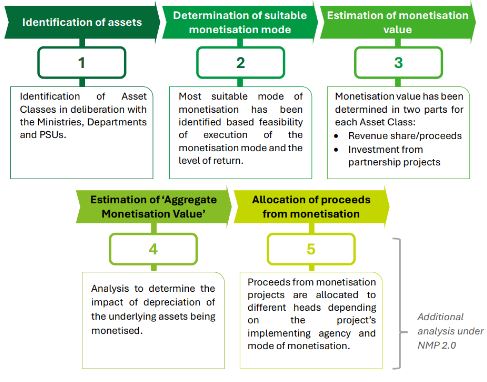
Revenue allocation from monetisation depends on the implementing agency:
- Ministry-led projects: credited to the Consolidated Fund of India.
- PSU/Port Authority projects: retained by the respective entity.
- Mining-related revenues: flow to the State Consolidated Fund (largely through royalties).
- Private investments involving construction or major maintenance are recorded under a separate accounting head.
Monetisation Instruments
Transactions under NMP 2.0 will employ a mix of financial and contractual instruments:
- Public-Private Partnership (PPP) concessions
- Infrastructure Investment Trusts (InvITs)
- Securitisation of cash flows
These instruments aim to attract long-term institutional investors such as pension funds and sovereign wealth funds, thereby deepening India’s infrastructure finance market.
Significance in the Context of Viksit Bharat
Aligned with the broader vision of Viksit Bharat, NMP 2.0 seeks to optimise public asset utilisation and crowd in private capital for infrastructure expansion. By providing medium-term asset visibility and a clear roadmap, it enhances investor confidence and predictability.
At a macroeconomic level, the pipeline complements the government’s high capital expenditure strategy, supports economic growth, and strengthens fiscal sustainability. If implemented effectively with transparency and robust regulatory safeguards, NMP 2.0 could institutionalise asset monetisation as a permanent pillar of India’s public finance architecture.