
Kodaikanal Solar Observatory (KoSO)
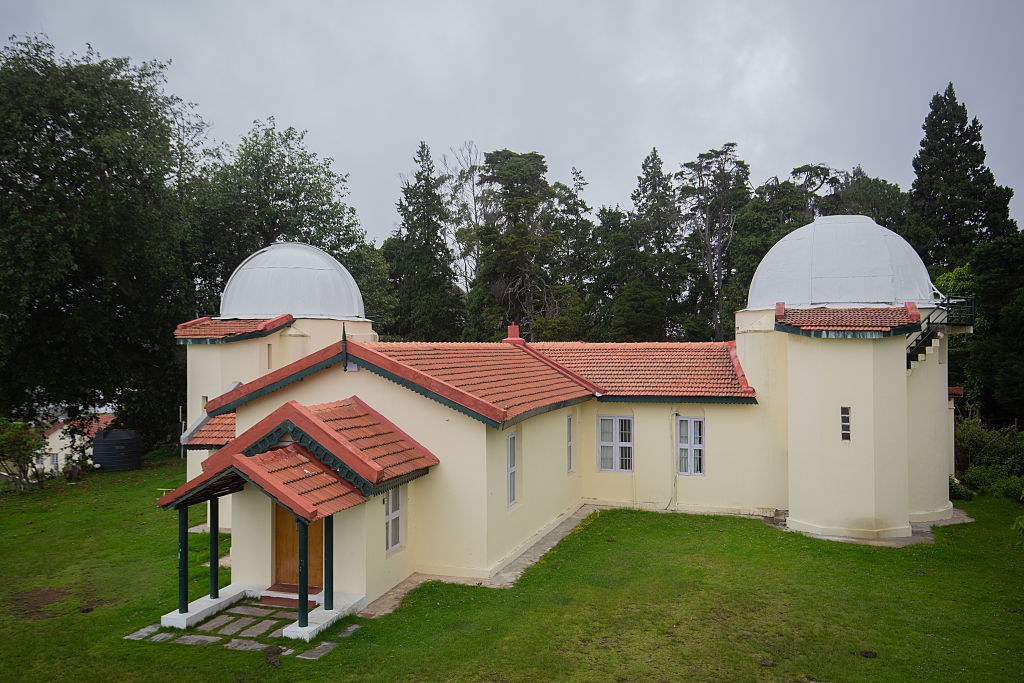
- 21 Nov 2025
In News:
Scientists led by Aryabhatta Research Institute of Observational Sciences (ARIES), along with Indian Institute of Astrophysics (IIA) and international collaborators, have reconstructed over 100 years (1904–2022) of the Sun’s polar magnetic history using archival observations from the Kodaikanal Solar Observatory (KoSO).
About Kodaikanal Solar Observatory (KoSO)
- What it is: One of the world’s oldest continuously operating solar observatories.
- Location: Palani Hills, Tamil Nadu; functions as a field station of IIA, Bengaluru.
- Established:1899.
- Unique Data Legacy:Systematic Ca II K solar imaging since 1904, creating among the longest uninterrupted solar datasets globally.
- Observations: Multi-wavelength views of the chromosphere, capturing plages, sunspot groups and magnetic networks.
- Access: Large portions of the digitised archive are publicly available for global research.
What is the Sun’s Magnetic Future?
- Refers to the behaviour of the Sun’s polar magnetic fields, which drive the 11-year solar cycle, sunspots, flares and geomagnetic storms affecting Earth.
- Challenge: Direct polar magnetic field measurements began only in 1976, leaving earlier decades undocumented.
Scientific Breakthrough
- Method: Researchers analysed KoSO’s Ca II K images and combined them with Rome-PSPT data using AI-based feature recognition.
- Key Proxy: Identification of faint bright structures near the poles—polar network—quantified through the Polar Network Index (PNI).
- Outcome:First reliable, century-long reconstruction of the Sun’s polar magnetic fields (1904–2022).
Why Ca II K Matters
- The Ca II K wavelength reveals chromospheric features tightly linked to magnetic activity.
- Plages and magnetic networks recorded in Ca II K act as historical fingerprints of solar magnetism, enabling reconstructions before direct measurements.
Significance
- Solar Cycle Prediction: Improves estimates of the strength of Solar Cycle 25 and future cycles.
- Space Weather Forecasting: Enhances prediction of solar storms that can disrupt GPS, communications, satellites, aviation and power grids.
- Open Science: Reconstructed datasets and PNI values are openly released (e.g., GitHub, Zenodo), accelerating global research.