
Fourier Transform Infrared Spectroscopy (FTIR) in Post-Blast Forensics
- 17 Nov 2025
In News:
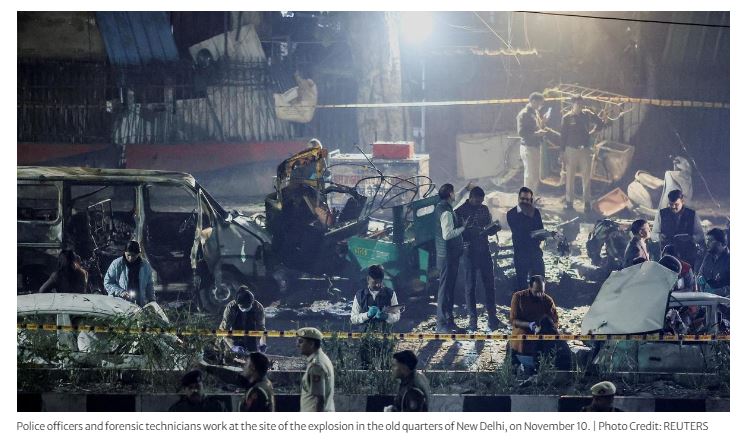
Recent investigative reports highlight the use of Fourier Transform Infrared Spectroscopy (FTIR) in forensic examinations following explosions, such as the blast near Delhi’s Red Fort on 10 November. Forensic experts from the Explosives Department of the Delhi Forensic Laboratory reached the scene promptly, collecting material for scientific analysis to determine the cause and nature of the explosion.
Role of Forensic Experts in Blast Investigations
- Immediate Objective: Identify the cause of the explosion - whether accidental or deliberate.
- Tasks at the Scene:
- Collect samples of debris, residues, metallic fragments, and vehicle parts.
- Document burn marks, pressure wave patterns, and dispersion of fragments.
- Preserve traces that may indicate type of explosive used or triggering mechanism.
- Lab Analysis:
- Rapid chemical and physical testing of recovered samples.
- Collaboration across divisions: explosives chemistry, ballistics, toxicology, materials science, and fingerprint/DNA units.
- Outcome: Scientific verification of:
- Type of explosive (commercial, military, improvised)
- Method of detonation (mechanical/electrical)
- Presence of accelerants or chemical signatures
- Identity of individuals involved (via biological traces)
FTIR plays a key role in this analytical pipeline.
What is FTIR (Fourier Transform Infrared Spectroscopy)?
- Also known as FTIR Analysis / FTIR Spectroscopy.
- An advanced analytical technique used to identify chemical constituents by studying molecular vibrational modes.
- Provides information about:
- Functional groups
- Molecular composition
- Chemical bonding and structure
How FTIR Works
- Uses infrared light to interact with a sample.
- Molecules absorb IR radiation at specific frequencies, corresponding to unique vibrational transitions.
- FTIR measures these absorption patterns, producing an infrared spectrum.
- The spectrum acts as a molecular fingerprint, enabling identification of:
- Organic compounds
- Polymers
- Explosive residues
- Molecular fragments or contaminants
Capabilities
- Effective for:
- Small particles (10–50 microns)
- Surface-level chemical mapping
- Solid, liquid, or gaseous samples
- Resistant to interference and highly precise.
Applications of FTIR
1. Forensic Science
- Identification of explosive residues (e.g., nitrates, nitro-aromatics)
- Analysis of burnt materials, accelerants, or chemical sensitizers
- Distinguishing between accidental combustion and explosive detonation
2. Industrial Quality Control
- Assessing composition of manufactured materials
- Ensuring consistency of polymers, coatings, adhesives, and composites
3. Environmental Monitoring
- Tracking pollutants in:
- Air (particulate matter, gases)
- Water (organic contaminants)
- Soil (industrial chemicals, toxins)
4. Chemical and Material Sciences
- Identification of organic and polymeric substances
- Limited use in analysing certain inorganic compounds
Significance in Blast Investigations
- Detects chemical signatures of commercial or improvised explosives.
- Helps determine:
- Type of explosive used
- Purity and formulation
- Possible source or manufacturer
- Assists in reconstructing the chain of events and intention behind the blast.
- Provides evidence admissible in court due to scientific validity.