
ESCAPEDE Mission
- 16 Nov 2025
In News:
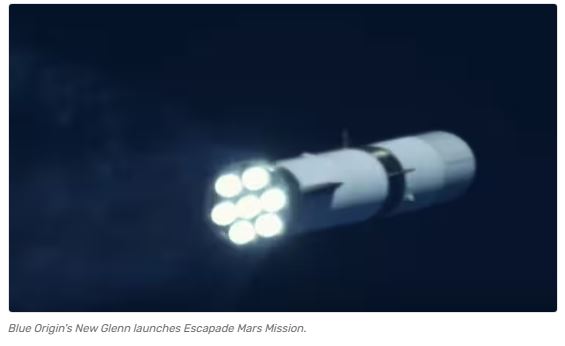
Blue Origin successfully launched NASA’s ESCAPADE (Escape and Plasma Acceleration and Dynamics Explorers) mission to Mars aboard the New Glenn heavy-lift rocket from Cape Canaveral.
The launch marks a major milestone for both interplanetary science and commercial reusable rocket technology.
About ESCAPADE Mission
ESCAPADE is NASA’s first coordinated dual-spacecraft orbital science mission to Mars.
Key Components
- Twin spacecraft named Blue and Gold.
- Designed for simultaneous observations from different regions of Martian space.
- Developed under NASA’s SIMPLEx (Small Innovative Missions for Planetary Exploration) program.
- Utilises a “launch and loiter” flight strategy:
- Spacecraft first travel toward the Sun–Earth Lagrange Point 2 (L2).
- They remain at L2 until the optimal Mars-transfer window opens.
- Cruise toward Mars in late 2026, with arrival expected by 2027.
Mission Objectives
- Study the interaction between the solar wind and the Martian magnetosphere.
- Investigate how space weather affects Mars’ atmospheric dynamics.
- Understand the process of atmospheric escape, a key factor behind:
- Mars losing its thick ancient atmosphere
- Decline in surface habitability
- Generate real-time data on:
- Magnetic field variations
- Plasma environment
- Solar wind–atmosphere coupling
These insights support future human exploration and long-term Mars climate modelling.
Scientific Rationale
- The solar wind continually erodes Mars’ upper atmosphere.
- By observing from dual vantage points, ESCAPADE will map:
- Plasma flow patterns
- Energy transfer from solar particles
- Changes in the induced magnetosphere over time
- Understanding these processes helps reconstruct the planet’s evolution and potential for past habitability.
Launch Details and Timeline
- Launched using Blue Origin’s New Glenn rocket.
- Mission timeline:
- Up to one year in Earth orbit (loiter phase)
- Mars transit: 2026–2027
- Science operations: 2027–2029
Significance of Blue Origin’s Role
- Advancement in Heavy-Lift Commercial Launches
- This was the second flight of the 321-foot New Glenn rocket.
- Demonstrates Blue Origin’s readiness for planetary missions.
- Breakthrough in Reusability
- Rocket’s first stage successfully landed on the recovery ship “Jacklyn” in the Atlantic.
- Places Blue Origin alongside SpaceX in recovering large boosters.
- Enhances competitiveness in:
- NASA contracts
- Deep-space mission launches
- Commercial satellite markets
- Expansion of Infrastructure
- Over $1 billion invested in Florida launch facilities.
- Signals Blue Origin’s long-term commitment to reusable, cost-efficient spaceflight.