
Astrophysical Jets
- 13 Nov 2025
In News:
Astrophysical jets are highly collimated outflows of ionised matter (plasma) ejected at relativistic speeds from extreme celestial environments such as black holes, neutron stars, and pulsars. Understanding their plasma composition is crucial to decoding the physical processes operating near these compact objects.
What are Astrophysical Jets?
- Extended, beam-like streams of plasma emitted along the rotation axes of compact objects.
- Travel vast distances (from parsecs to kiloparsecs) and interact with surrounding interstellar or intergalactic media.
- Powered by strong gravitational and magnetic fields near compact objects.
Why Plasma Composition Matters
- For decades, it has been unclear whether jets are composed of:
- Electron-positron pairs, or
- Electron-proton plasma, or
- A mixture of electrons, positrons, and protons.
- Plasma composition determines the jet’s:
- Internal energy
- Propagation speed
- Shock structure
- Stability and turbulence
- These properties directly affect how jets evolve and how they appear in astronomical observations.
Recent Scientific Findings
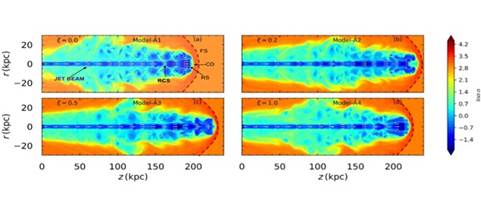
Scientists from the Aryabhatta Research Institute of Observational Sciences (ARIES), an autonomous institute under the Department of Science and Technology, have studied how plasma composition influences jet dynamics.
- The research, used:
- A relativistic equation of state (accounting for plasma composition),
- Advanced numerical simulations of jet propagation.
- The findings were published in the Astrophysical Journal.
Key Results of the Study
- Jets with identical initial conditions (same density, pressure, and Lorentz factor) can behave very differently solely due to plasma composition.
- Electron–positron jets were found to be slowest, despite positrons being much lighter than protons.
- Electron–proton jets propagate faster because plasma composition alters the thermodynamic properties of the jet.
- This result is counter-intuitive, as protons are about 2,000 times heavier than electrons or positrons.
Impact on Jet Structure and Stability
- Plasma composition affects:
- Number and strength of recollimation shocks (shocks formed due to interaction with backflowing material),
- Shape and dynamics of reverse shocks,
- Degree of turbulence within the jet.
- Electron–positron jets develop stronger turbulent structures, leading to:
- Jet deceleration,
- Reduced long-term stability.