
Asiatic Caracal
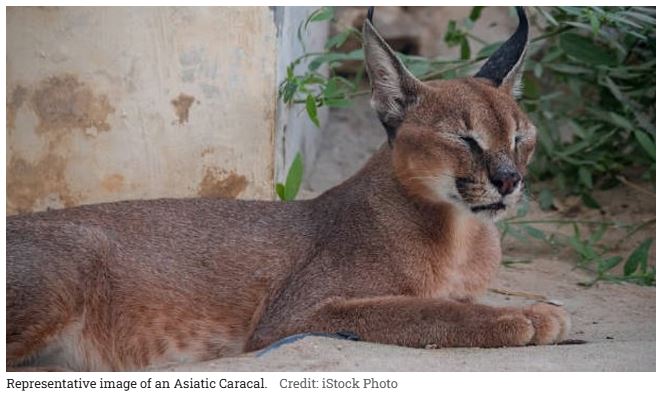
- 20 Nov 2025
In News:
The elusive Asiatic Caracal was recently sighted at Ramgarh in Jaisalmer, marking a significant wildlife record for Rajasthan. Once widespread across India’s grasslands and semi-arid regions, the species had nearly disappeared from public consciousness due to its extremely low numbers and elusive behaviour.
About the Caracal
- Scientific Name:Caracal caracal
- Common Names: Desert lynx (misnomer); Siya gosh in India (Persian for “black ear”)
- Taxonomy: More closely related to the African golden cat and serval than to lynxes
- Type: Medium-sized wild cat, shy and predominantly nocturnal
Distribution
- Global: Africa, Central Asia, the Middle East, arid regions of Pakistan, and north-western India
- India: Extremely rare; estimated population of ~50 individuals, mainly confined to Rajasthan and Gujarat
Habitat
- Occupies semi-deserts, savannahs, shrublands, steppes, dry forests, and woodlands
- Strong preference for dry areas with low rainfall
Key Physical & Behavioural Features
- Solid build, long legs, short face, and distinctive black ear tufts
- Coat colour ranges from red-tan to sandy, with occasional black individuals
- Dark facial markings near eyes and nose; short, dense fur
- Back legs longer than front, aiding agility
- Exceptional leaper: can jump up to 3 metres (10 feet) to catch birds mid-air
- Speed: up to 80 km/h (50 mph) in short bursts
- Largely nocturnal and elusive, making sightings rare
Conservation Status
- IUCN Red List:Least Concern (globally)
- Indian Context: Despite global status, the species is locally threatened due to habitat loss, fragmentation, and very small population size