
23rd Foundation Day of National Commission for Scheduled Tribes
- 22 Feb 2026
In News:
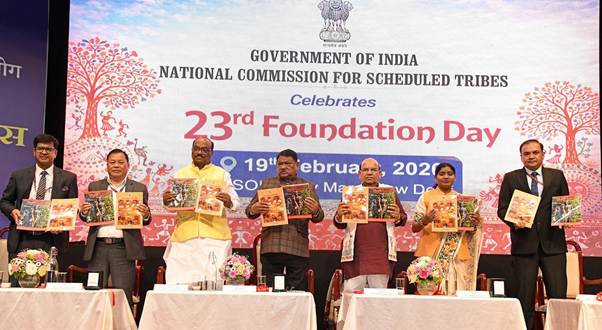
The 23rd Foundation Day of the National Commission for Scheduled Tribes (NCST) was celebrated in New Delhi by the Ministry of Tribal Affairs.
- Union Tribal Affairs Minister Jual Oram released the NCST Handbook detailing the Commission’s mandate and functioning.
- The event highlighted:
- NCST’s constitutional responsibilities
- Policy recommendations
- Grievance redressal initiatives
- Field visits to Scheduled Areas
- The Commission reiterated focus areas such as education, forest rights, land issues, infrastructure, and livelihood generation for tribal communities.
About National Commission for Scheduled Tribes (NCST)
Constitutional Status
- Established under Article 338-A of the Constitution.
- Created by the 89th Constitutional Amendment Act, 2003, which bifurcated the earlier National Commission for SCs and STs.
- Aims to provide focused attention to the distinct problems of Scheduled Tribes (STs).
Composition
- Chairperson
- Vice-Chairperson
- Three other Members (at least one woman)
- Appointed by the President by warrant under his hand and seal.
Tenure & Status
- Tenure: 3 years.
- Not eligible for more than two terms.
- Chairperson: Rank of Union Cabinet Minister.
- Vice-Chairperson: Rank of Minister of State.
- Members: Rank of Secretary to Government of India.
Core Functions
- Investigate and monitor safeguards for STs under the Constitution and laws.
- Inquire into complaints regarding deprivation of tribal rights.
- Participate in socio-economic development planning.
- Evaluate development progress of STs.
- Submit annual/periodic reports to the President.
- Recommend measures to Union and State Governments.
Additional Functions (Specified in 2005)
- Ownership rights over Minor Forest Produce (MFP).
- Safeguarding rights over mineral and water resources.
- Preventing land alienation of tribals.
- Monitoring implementation of the Panchayats (Extension to Scheduled Areas) Act (PESA), 1996.
- Relief and rehabilitation of displaced tribals.
- Addressing shifting cultivation issues.
Powers of NCST
- Powers of a civil court during investigations:
- Summon persons
- Require production of documents
- Receive affidavits
- Requisition public records
- Can regulate its own procedure.
- Mandatory consultation: Central and State Governments must consult NCST on major policy matters affecting STs.
Reporting Mechanism
- Submits reports to the President.
- Reports laid before Parliament with Action Taken Memorandum.
- State-specific reports forwarded to Governor for placement before State Legislature.
Constitutional Provisions Related to Scheduled Tribes (STs)
Identification of STs
- Article 366(25): defines Scheduled Tribes (STs) as tribes or tribal communities, or parts thereof, that are deemed under Article 342 to be STs for the purposes of the Constitution.
- Article 342(1) empowers the President to specify tribes as STs in consultation with the Governor for states.
Administrative Provisions
- Fifth Schedule: Applies to Scheduled Areas in states other than Sixth Schedule states.
- Sixth Schedule: Provides Autonomous District Councils in: Assam, Meghalaya, Tripura, and Mizoram
Key Legislations for ST Protection
- Protection of Civil Rights Act, 1955
- SC/ST (Prevention of Atrocities) Act, 1989
- PESA Act, 1996
- Forest Rights Act, 2006