
Revitalizing India’s Apprenticeship Ecosystem
- 23 Feb 2026
In News:
NITI Aayog’s report “Revitalizing Apprenticeship Ecosystem” highlights low completion rates (only 2.51 lakh completed out of 13.1 lakh registrations in 2024–25) and calls for a National Apprenticeship Mission and targeted reforms to strengthen India’s skilling strategy.
Launch of Policy Report
- NITI Aayog launched a policy report titled “Revitalizing Apprenticeship Ecosystem: Insights, Challenges, Recommendations and Best Practices.”
- The report provides a comprehensive review of India’s apprenticeship system and suggests reforms to make it a cornerstone of India’s skilling and employment framework.
Apprenticeship: Concept and Importance
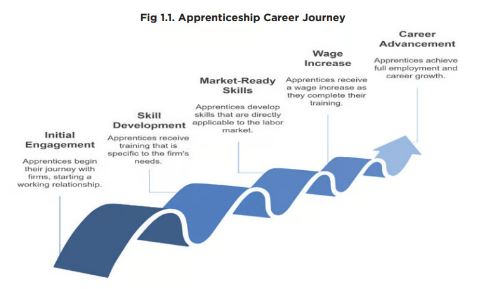
- Apprenticeship is a structured, work-based learning model that bridges the gap between formal education and employment.
Significance
- Provides industry-relevant skills to youth
- Enhances productivity and innovation for businesses
- Reduces skill mismatch in labour markets
- Facilitates smoother school-to-work transition
Demographic Imperative
- Youth (15–29 years) constituted 27.2% of India’s population in 2021
- India projected to have ~345 million youth by 2036 (largest globally)
To convert this demographic potential into a demographic dividend, strengthening the apprenticeship and skilling ecosystem is critical.
Current Landscape of Apprenticeship (2024–25 Data)
1. Gap in Registration and Completion
- Registrations: 13.1 lakh (1.31 million)
- Engaged: 9.85 lakh (985,000)
- Completed training: 2.51 lakh (251,000)
Significant drop between registration, engagement, and completion.
2. Enterprise Participation
- Medium & large enterprises:
- <30% of active establishments
- Account for >70% of apprenticeship engagement
- Low participation by:
- MSMEs
- Start-ups
- Informal sector
3. Gender Gap
- Male participants dominate registrations and engagements
- Limited targeted support for women and marginalized groups
4. Regional Disparities
- Top 10 states contribute 79–84% of total engagement
- Low participation from:
- North-East states
- Union Territories
- Significant district-level variation within states
Key Recommendations by NITI Aayog
1. Policy Reforms
- Establish a National Apprenticeship Mission
- Develop a unified National Apprenticeship Portal
- Provide targeted incentives for:
- Aspirational districts
- North-East states
- Women apprentices
2. Regulatory Measures
- Create an Apprenticeship Engagement Index for benchmarking States/UTs
- Conduct robust evaluation of apprentice competencies
3. State & District-Level Interventions
- Focus on “high-potential but low-performing” districts
- Recognition/reward initiative for Top 25 districts based on growth
4. Enhancing Enterprise Participation
- Cluster-based approach for MSMEs
- Integration with start-up ecosystem
- Alignment with gig and platform economy
5. Support for Women & Marginalized Sections
- Travel and accommodation assistance
- Expanded insurance coverage
- Structured career counselling
- International mobility pathways
- Targeted measures to enhance women’s inclusion
Key Government Initiatives
1. National Apprenticeship Promotion Scheme (NAPS), 2016
- Implemented by Ministry of Skill Development & Entrepreneurship
- Target group: 14–35 years
- Incentives:
- Government shares 25% of stipend (up to ?1,500/month)
- Reimbursement of basic training costs
2. National Apprenticeship Training Scheme (NATS)
- Administered by Ministry of Education
- For graduate and diploma holders
- Provides 6 months to 1 year structured on-the-job training