
Gaganyaan Drogue Parachute
- 22 Feb 2026
In News:
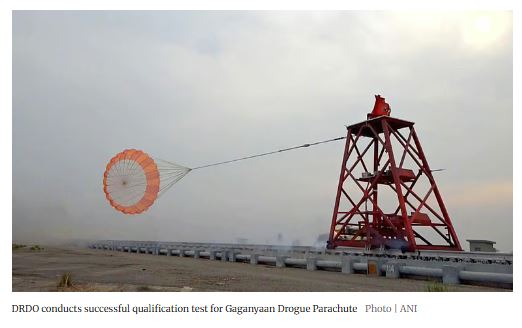
India achieved a significant milestone in its human spaceflight programme as the Defence Research and Development Organisation (DRDO) successfully conducted a qualification-level load test of the Drogue Parachute for the Gaganyaan mission.
- Test conducted at the Terminal Ballistics Research Laboratory (TBRL), Chandigarh.
- Utilised the Rail Track Rocket Sled (RTRS) facility to simulate dynamic flight conditions.
- The parachute was tested under loads higher than expected flight loads to validate safety and reliability.
What is the Gaganyaan Drogue Parachute?
- A crucial component of the Crew Module deceleration system.
- Deployed during atmospheric re-entry.
- Functions to:
- Stabilize the Crew Module.
- Reduce velocity before main parachutes deploy.
- Ensure safe splashdown/landing of astronauts.
Developed collaboratively by:
- Indian Space Research Organisation (ISRO)
- DRDO
Gaganyaan Deceleration System
The Crew Module recovery system consists of 10 parachutes (4 types):
- Apex Cover Separation Parachutes (2): Remove protective apex cover.
- Drogue Parachutes (2): Stabilize module at high altitude, Reduce velocity during transition phase.
- Pilot Parachutes (3): Extract main parachutes.
- Main Parachutes (3): Provide final deceleration for safe landing.
The drogue parachutes serve as the critical transition stage, ensuring controlled descent before deployment of main canopies.
Key Technical Features
- High-strength ribbon parachute design
- Ribbon-type structure allows controlled airflow.
- Reduces shock loads.
- Ensures high tensile strength during high-speed descent.
- Qualification-level testing
- Tested beyond maximum expected flight loads.
- Enhances mission safety margins.
- Designed for extreme conditions
- Capable of functioning under:
- Rapid velocity changes
- Turbulence
- Variable atmospheric pressures
- Capable of functioning under:
- Dynamic validation: High-speed testing using RTRS facility simulates near-real re-entry conditions.
Significance for India’s Human Spaceflight Programme
- Strengthens safety architecture of Gaganyaan.
- Demonstrates indigenous capability in complex recovery systems.
- Enhances collaboration between ISRO and DRDO.
- Critical for safe astronaut recovery after orbital mission.