
India’s Drone Ecosystem
- 20 Feb 2026
In News:
As of February 2026, India has over 38,500 registered drones (UINs), 39,890 DGCA-certified remote pilots, and 244 approved training organisations, reflecting a mature and regulated drone ecosystem.
India has transitioned from experimental drone usage to a structured, innovation-driven ecosystem integrated into governance, agriculture, infrastructure, and defence.
Evolution of India’s Drone Ecosystem
Over two decades, drone technology in India has evolved into a comprehensive framework involving:
- Manufacturers and component developers
- Drone-as-a-Service (DaaS) providers
- Start-ups and MSMEs
- Certified pilots and training institutes
- Digital regulatory platforms
Drones are now embedded in public service delivery, infrastructure monitoring, precision agriculture, disaster response, and national security.
Major Applications
1. Agriculture and Farmer Services
- Integrated with PMFBY (Pradhan Mantri Fasal Bima Yojana) for crop assessment.
- Used for precision spraying, crop monitoring and input optimisation.
Namo Drone Didi Scheme (2023)
- Provides drones to Women Self-Help Groups (SHGs).
- 1,094 drones distributed, including 500 under the core initiative.
- Enhances productivity, reduces costs, and promotes women-led rural entrepreneurship.
2. Land Mapping – SVAMITVA Scheme
The SVAMITVA (Survey of Villages and Mapping with Improvised Technology in Village Areas) scheme (launched April 2020) uses drones for mapping rural abadi areas.
Key Data (as of Dec 2025):
- Target: ~3.44 lakh villages
- 3.28 lakh villages surveyed (~95%)
- 2.76 crore property cards prepared
- Covers 1.82 lakh villages across 31 States/UTs
Objectives:
- Reduce land disputes
- Improve access to institutional credit
3. Highway and Infrastructure Monitoring
- NHAI mandates monthly drone video recording of highway projects.
- Footage stored in data lakes for audit and dispute resolution.
- Enhances transparency and project monitoring.
4. Railways
- Ministry of Railways deploying UAVs for inspection of tracks and bridges.
- Railway Protection Force uses drones for surveillance and crowd management.
- Improves safety and monitoring of critical infrastructure.
5. Disaster Management
- NECTAR (North East Centre for Technology Application and Reach) developed specialised drones for flood and landslide monitoring.
- Provides real-time aerial visuals to improve rescue coordination.
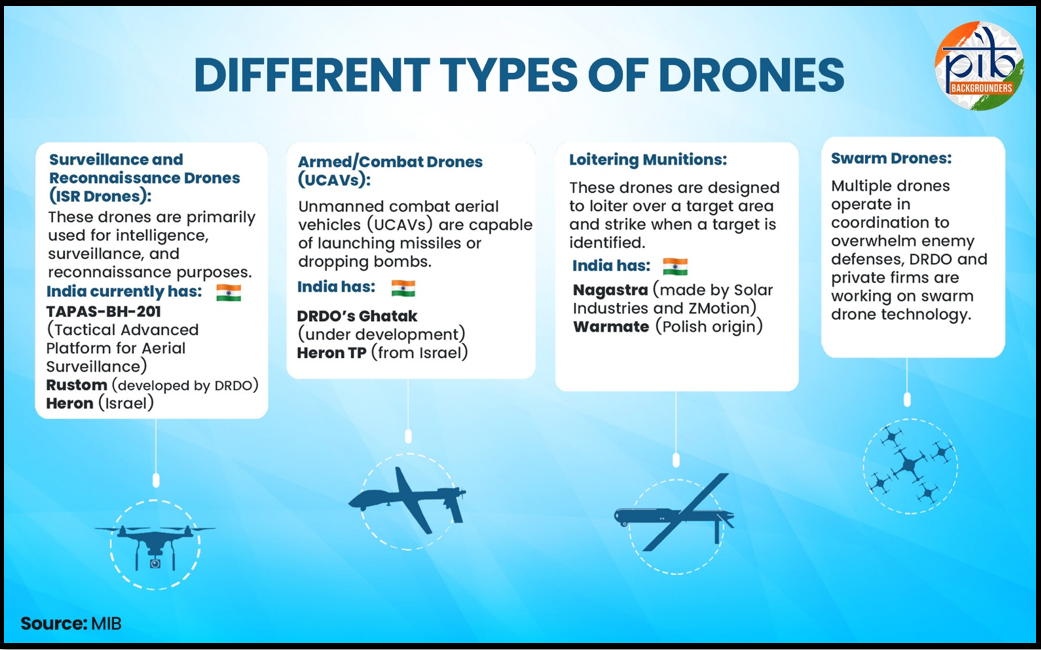
6. Defence Applications
- Used for border surveillance, intelligence gathering and precision strikes.
- During Operation SINDOOR, drones and loitering munitions destroyed enemy targets.
- Integrated with radar and air defence systems for national security.
Policy and Regulatory Framework
1. Drone Rules, 2021 (Amended 2022–23)
Key reforms:
- Forms reduced from 25 to 5
- Approvals reduced from 72 to 4
- ~90% airspace designated as Green Zone (up to 400 ft)
- Pilot licence replaced by Remote Pilot Certificate (RPC)
- Civilian drones permitted up to 500 kg
- Passport requirement removed
2. Digital Sky & eGCA
- Regulatory services (registration, certification, RPTO authorisation) shifted to eGCA.
- Operational services (flight plans, airspace maps) integrated with Digital Sky.
Achievements (Feb 2026):
- 38,575 drones registered (UIN)
- 39,890 Remote Pilot Certificates issued
- 244 DGCA-approved RPTOs
3. Production Linked Incentive (PLI) Scheme
- Outlay: ?120 crore
- Promotes domestic drone and component manufacturing.
- Encourages MSMEs and start-ups.
4. GST Rationalisation
- GST reduced to 5% (September 2025) from earlier 18–28%.
- Applies to drones and flight simulators.
- Encourages commercial adoption and training ecosystem.
Capacity Building & Innovation
- SwaYaan Programme: HR development in Unmanned Aircraft Systems.
- 857 activities
- 26,000 beneficiaries
- National Innovation Challenge for Drone Application and Research (NIDAR)
- ?40 lakh prize pool
- Promotes autonomous drones in disaster management & agriculture
- Platforms like Bharat Drone Shakti and Bharat Drone Mahotsav promote DaaS and indigenous technologies.