
PM RAHAT (Road Accident Victim Hospitalization and Assured Treatment) Scheme
- 17 Feb 2026
In News:
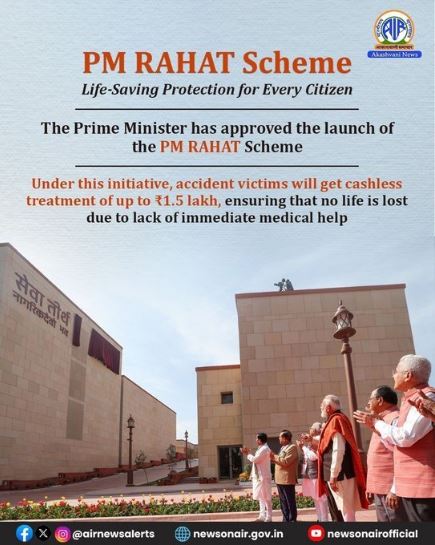
India records one of the highest numbers of road accident fatalities globally. A substantial proportion of these deaths occur due to delayed medical intervention during the critical “Golden Hour.” In this context, the Government of India launched the PM RAHAT (Road Accident Victim Hospitalization and Assured Treatment) Scheme to institutionalize timely, cashless, and technology-enabled trauma care. The scheme represents a structural reform in India’s road safety and emergency health response architecture.
Rationale: The Golden Hour Imperative
Studies indicate that nearly 50% of road accident deaths can be prevented if victims receive hospital treatment within the first hour of injury. However, barriers such as financial uncertainty, delayed ambulance response, and procedural bottlenecks often hinder prompt care. PM RAHAT addresses these systemic gaps through integrated digital platforms, assured financing, and district-level accountability.
Key Features of PM RAHAT
1. Cashless Treatment
- Every eligible road accident victim on any category of road is entitled to cashless treatment up to ?1.5 lakh per victim.
- Coverage is available for 7 days from the date of accident.
- Stabilization care:
- 24 hours for non-life-threatening cases
- 48 hours for life-threatening cases
- Treatment is subject to police authentication within defined timelines, without interrupting emergency care.
2. Integration with ERSS 112
The scheme is integrated with the Emergency Response Support System (ERSS) 112.
- Victims, Good Samaritans (Rah-Veer), or bystanders can dial 112 to locate the nearest designated hospital and request ambulance services.
- Ensures coordination between police, hospitals, and emergency responders to secure treatment within the Golden Hour.
3. Technology-Driven Implementation
PM RAHAT integrates:
- Electronic Detailed Accident Report (eDAR) of the Ministry of Road Transport and Highways, and
- Transaction Management System (TMS 2.0) of the National Health Authority.
This digital convergence ensures seamless linkage from accident reporting to hospital admission, authentication, claim processing, and reimbursement, enhancing transparency and efficiency.
Financing Mechanism
Reimbursements to hospitals are made through the Motor Vehicle Accident Fund (MVAF).
- If the offending vehicle is insured: payment is drawn from contributions made by General Insurance Companies.
- In uninsured or hit-and-run cases: payment is made through budgetary allocation by the Government of India.
- Approved claims by the State Health Agency must be settled within 10 days, providing financial certainty to hospitals and incentivizing participation.
Grievance Redressal and Accountability
- A Grievance Redressal Officer is nominated by the District Road Safety Committee.
- The Committee is chaired by the District Collector/District Magistrate/Deputy Commissioner, ensuring district-level oversight and accountability.
- Police confirmation timelines (24–48 hours) maintain institutional discipline while safeguarding emergency care.
Significance
- Human-Centric Governance: Ensures that no victim is denied treatment due to inability to pay.
- Strengthening Road Safety Framework: Complements broader road safety initiatives under the Motor Vehicles (Amendment) Act.
- Digital Governance Model: Demonstrates effective integration of transport, health, insurance, and policing databases.
- Encouragement of Good Samaritans: Reduces hesitation in assisting victims by providing structured institutional backing.