
Ol Chiki at 100
- 18 Feb 2026
In News:
The centenary of the Ol Chiki (1925–2025) is being commemorated by the Ministry of Culture, with the inaugural function held in New Delhi. The occasion is marked by the release of a ?100 commemorative coin and a special postage stamp, symbolising national recognition of a that transformed the Santhali language from an oral tradition into a structured written medium. The milestone reflects not merely a linguistic achievement but a broader assertion of tribal identity and cultural dignity.
Historical Background and Genesis
For centuries, Santhali—belonging to the Austroasiatic (Munda) language family—was sustained through rich oral traditions of folklore, songs, rituals, and storytelling. However, the absence of a dedicated limited formal documentation, education, and literary standardisation. Prior to the 20th century, Santhali was transcribed using borrowed s such as Roman, Bengali, Odia, and Devanagari, which inadequately represented its distinctive phonetic features, including glottal stops and unique vowel patterns.
Recognising this gap, Pandit Raghunath Murmu (1905–1982) developed the Ol Chiki in 1925. Revered as Guru Gomke (Great Teacher), he sought to provide Santhali with a scientifically designed and culturally rooted writing system. His seminal literary work, High Serena (1936), was among the first books written in Ol Chiki, followed by other influential writings that strengthened linguistic awareness and literacy.
Linguistic Features of Ol Chiki
Ol Chiki is distinguished by its phonetic precision and indigenous design:
- 30 letters, representing vowels and consonants
- One symbol corresponds to one sound (direct phonetic mapping)
- Accurately captures glottal stops and unique phonetic elements
- No conjunct letters, ensuring structural simplicity
- Not derived from Brahmi or Roman s
Unlike adapted s, Ol Chiki was created exclusively for Santhali phonology, enabling accurate recording of vocabulary, grammar, and pronunciation. It facilitated standardisation in education, translation, and publication.
Constitutional and Institutional Recognition
A major milestone came in 2003 when Santhali was included in the Eighth Schedule of the Constitution through the 92nd Constitutional Amendment Act. This inclusion institutionalised the language within India’s formal linguistic framework, enabling its use in education, public administration, competitive examinations, and literary promotion.
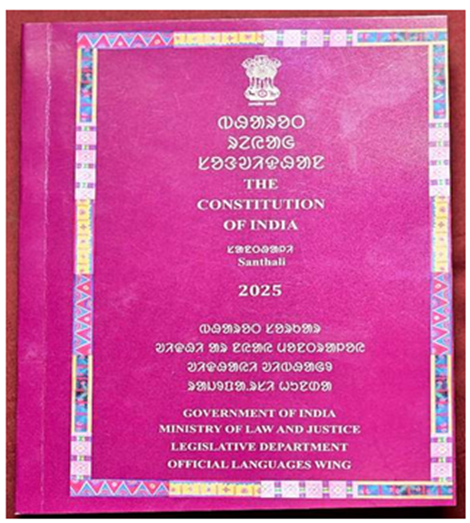
In December 2025, the Constitution of India was officially translated into Santhali using Ol Chiki. This initiative enhanced democratic accessibility by enabling Santhali-speaking citizens to engage directly with constitutional provisions, including tribal safeguards under the Fifth and Sixth Schedules. It marked a step toward linguistic justice and participatory governance.
National Commemoration
To mark 100 years of Ol Chiki, the Government of India has issued:
- A ?100 commemorative coin, featuring the Lion Capital of Ashoka on the obverse and a portrait of Pandit Raghunath Murmu alongside Ol Chiki characters on the reverse.
- A commemorative postage stamp, reinforcing philatelic recognition of cultural milestones.
These symbolic gestures affirm the ’s role in preserving indigenous heritage within India’s pluralistic framework.