
LHS 1903 Planetary System
- 18 Feb 2026
In News:
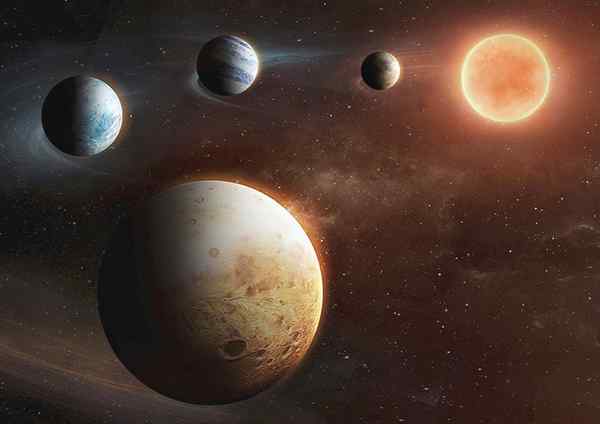
Astronomers using the European Space Agency’s Cheops (Characterising Exoplanet Satellite) telescope have discovered an unusual four-planet system orbiting the red dwarf star LHS 1903, located approximately 117 light-years from Earth. The system’s planetary arrangement contradicts conventional models of planet formation, offering fresh insights into the dynamics of exoplanetary systems.
System Overview
The LHS 1903 system consists of four planets:
- Two rocky Super-Earths
- Two gaseous mini-Neptunes
These planets orbit a relatively small and dim red dwarf (M-dwarf) star.
Characteristics of the Host Star
- Mass: ~50% of the Sun’s mass
- Luminosity: ~5% of the Sun’s brightness
- Cooler and less luminous than the Sun
- Red dwarfs are the most common type of star in the Milky Way
Given their abundance and longevity, red dwarfs are important targets in the search for potentially habitable exoplanets.
Planetary Composition
- Super-Earths (Rocky Planets)
- Similar composition to Earth
- Mass between 2 to 10 times that of Earth
- Solid surfaces
- Mini-Neptunes (Gaseous Planets)
- Larger than Earth but smaller than Neptune
- Possess thick gaseous envelopes
- Often rich in hydrogen and helium
The sequence of planets from the star outward is as follows:
- Innermost: Rocky (Super-Earth)
- Middle two: Gaseous (Mini-Neptunes)
- Outermost (Fourth planet): Rocky (Super-Earth)
The Formation Paradox
Traditional models of planetary formation suggest that:
- Rocky planets form closer to the host star, where high temperatures prevent gas accumulation.
- Gas giants and gaseous planets form farther out, where volatile compounds can condense.
However, in the LHS 1903 system, the outermost planet is rocky, even though it lies beyond two gaseous planets. According to classical theory, it should have retained a substantial gaseous envelope.
Possible Explanations
Researchers propose two leading hypotheses:
- Sequential Formation Model: The planets may not have formed simultaneously. Instead, the inner planets could have formed first, consuming much of the available gas in the protoplanetary disk. By the time the fourth planet formed, insufficient gas remained for it to develop a thick atmosphere.
- Atmospheric Loss Hypothesis: The outer rocky planet may originally have possessed a gaseous envelope but later lost it due to a catastrophic event such as stellar radiation, atmospheric stripping, or collision, leaving behind a dense rocky core.
Both possibilities challenge the simplicity of existing models and suggest that planet formation may be more dynamic and episodic than previously understood.
Habitability Potential
The outer rocky planet has an estimated surface temperature of approximately 60°C. While relatively warm, this temperature falls within a theoretical range that does not automatically preclude habitability, especially if atmospheric or geological conditions are favorable.
Given the long lifespans of red dwarf stars, such systems are considered promising in the search for habitable exoplanets.
Scientific Significance
The LHS 1903 system provides:
- A test case for refining planet formation theories
- Insights into atmospheric evolution and planetary migration
- Evidence that planetary architectures may be more diverse than predicted
As observational capabilities improve, discoveries like this will deepen understanding of how planetary systems evolve and expand the scope of astrobiological exploration.