
India’s First Underwater Road-cum-Rail Tunnel under the Brahmaputra
- 17 Feb 2026
In News:
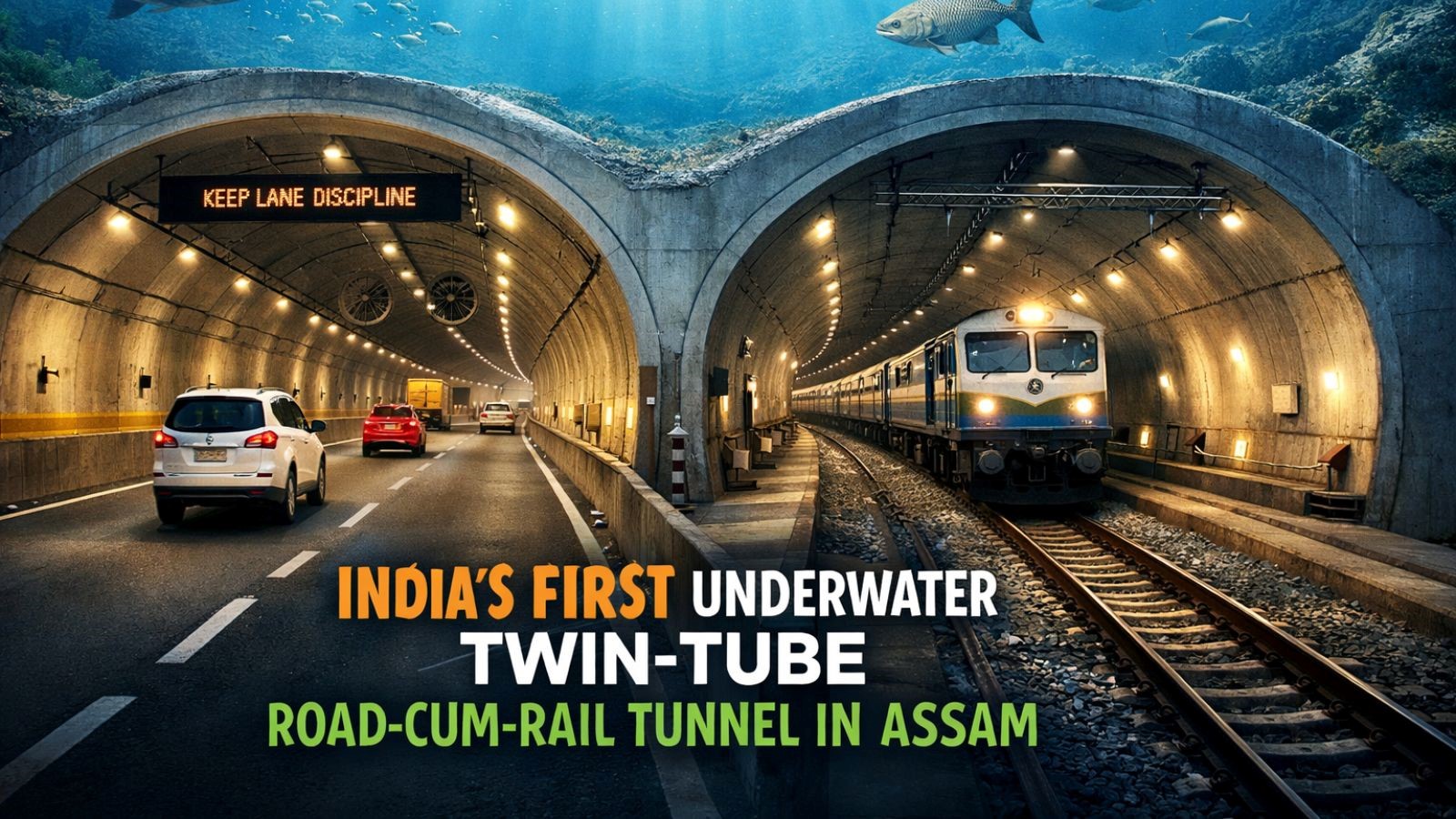
The Cabinet Committee on Economic Affairs (CCEA) has approved the construction of India’s first underwater twin-tube road-cum-rail tunnel beneath the Brahmaputra River in Assam at a total capital cost of ?18,662 crore. The 33.7 km access-controlled greenfield corridor, including a 15.79 km underwater tunnel, marks a milestone in India’s infrastructure engineering and is expected to significantly enhance connectivity across the Northeast.
Project Overview
What the Project Entails
- Total Length: 33.7 km
- Underwater Twin-Tube Tunnel: 15.79 km beneath the Brahmaputra
- Corridor: Gohpur (NH-15) to Numaligarh (NH-715)
- Development Mode: Engineering, Procurement and Construction (EPC)
- Total Capital Cost: ?18,662 crore
- Civil Cost: ?11,982.36 crore
- Land Acquisition: ?716.65 crore
The project integrates road and rail infrastructure, making it India’s first underwater road-cum-rail tunnel and only the second such structure globally.
Key Engineering Features
- Twin-Tube Design: Two parallel tubes ensure traffic segregation, safety redundancy, and efficient emergency evacuation systems. One tube will also incorporate railway infrastructure.
- Access-Controlled Greenfield Corridor: A four-lane highway designed for high-speed, uninterrupted travel.
- Multi-Modal Integration:
- Connects NH-15 and NH-715
- Integrates with Rangia–Mukongselek and Furkating–Mariani railway sections under Northeast Frontier Railway
- Links 4 major railway stations, 2 airports (Holongi and Tezpur), and 2 inland waterway terminals
- Traffic and Logistics Impact:
- Reduces distance from 240 km to 34 km
- Cuts travel time from 6 hours to 20 minutes
- Estimated AADT (FY-25): 4,680 PCUs
About the Brahmaputra River
The Brahmaputra is one of Asia’s largest rivers, originating from the Chemayungdung Glacier near Lake Mapam in Tibet (~5,300 m). Known as Yarlung Tsangpo in Tibet, Siang/Dihang in Arunachal Pradesh, and Jamuna in Bangladesh, it flows through China, India, and Bangladesh.
- Length: ~2,900 km
- Among the world’s highest average river discharges
- Forms the world’s largest delta with the Ganga
- Characterised by highly braided channels in Assam
Constructing an underwater tunnel beneath such a dynamic and sediment-laden river demonstrates advanced tunnelling and geotechnical capability.
Regional and Strategic Significance
1. Boost to Northeast Connectivity: Though located in Assam, the project benefits Arunachal Pradesh, Nagaland, and the wider Northeast region, improving passenger and freight mobility.
2. Economic Multiplier Effects
- Connects 11 economic nodes, including industrial areas and logistics hubs.
- Facilitates faster freight movement and reduces logistics costs.
- Expected to generate 80 lakh person-days of employment (direct and indirect).
3. Tourism and Social Connectivity
- Enhances access to Kaziranga National Park and Deopahar Archaeological Site.
- Connects aspirational districts like Udalguri and Darrang and tribal district Dima Hasao.
4. Strategic and Border Importance: Improves connectivity to Arunachal Pradesh, strengthening infrastructure in border areas and enhancing national security preparedness.