
Western Ghats Ecologically Sensitive Area (ESA)
- 26 Jun 2026
In News:
The Western Ghats Ecologically Sensitive Area (ESA) notification, currently valid until July 2026, has once again come under focus as six State governments continue to oppose the finalisation of ESA boundaries. The issue reflects the ongoing challenge of balancing ecological conservation with developmental needs.
Why are the Western Ghats Important?
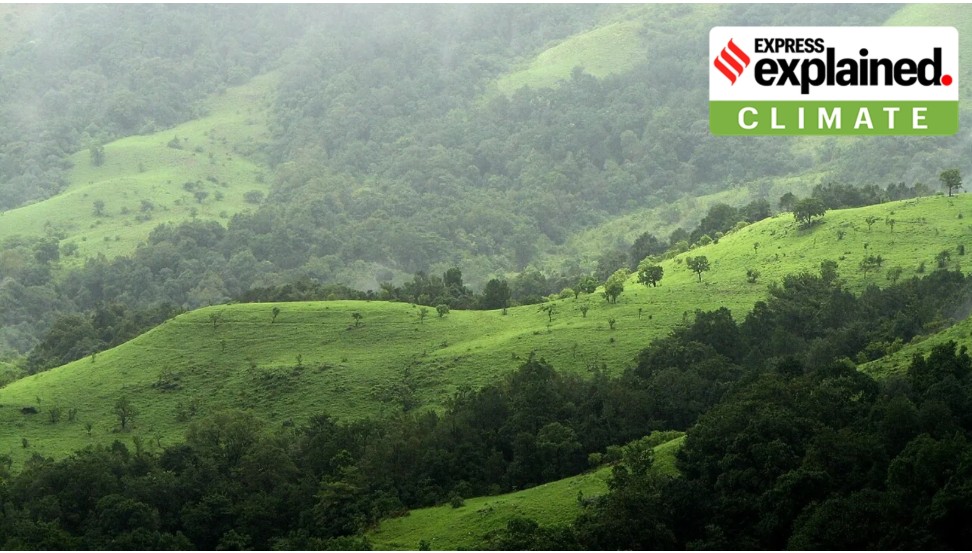
The Western Ghats are a nearly continuous mountain range stretching about 1,500 km along India's western coast across Gujarat, Maharashtra, Goa, Karnataka, Kerala, and Tamil Nadu. Recognised as one of the world's eight "hottest hotspots" of biodiversity and a UNESCO World Heritage Site, they harbour thousands of endemic species of flora and fauna.
Beyond biodiversity, the Ghats play a crucial role in India's ecological security. They intercept the southwest monsoon, receive heavy rainfall, and serve as the source of major peninsular rivers such as the Godavari, Krishna, Cauvery, and Periyar, supporting agriculture, drinking water, hydropower generation, and livelihoods for millions.
Unlike many protected ecosystems, the Western Ghats are also densely populated and support plantation agriculture, including coffee, pepper, cardamom, tea, cinnamon, mango, and jackfruit, making conservation particularly challenging.
What is an Ecologically Sensitive Area (ESA)?
An Ecologically Sensitive Area (ESA) is a region notified by the Central Government under the Environment (Protection) Act, 1986, to protect environmentally fragile ecosystems from activities that could cause irreversible ecological damage.
Within an ESA, environmentally harmful activities such as:
- Mining and quarrying
- Red-category polluting industries
- Thermal power plants
- Large-scale construction and township projects
are either prohibited or subject to strict regulation to ensure sustainable development.
Evolution of the Western Ghats ESA Proposal
The demand for protecting the Western Ghats led to the constitution of the Western Ghats Ecology Expert Panel (WGEEP) under Madhav Gadgil in 2010.
The Gadgil Committee (2011) recommended that the entire Western Ghats (1,29,037 sq km) be declared an Ecologically Sensitive Area with stringent restrictions on developmental activities. However, the recommendations faced widespread opposition from State governments and local communities due to concerns over livelihoods and economic development.
Subsequently, the Government appointed a High-Level Working Group under Dr. K. Kasturirangan in 2012 to review the Gadgil Report.
The Kasturirangan Committee (2013) adopted a more balanced approach. It distinguished between 'natural landscapes' and 'cultural landscapes', recognising that nearly 60% of the Western Ghats had already been modified through agriculture, plantations, and settlements. The committee therefore recommended that only about 60,000 sq km of ecologically intact natural landscapes be notified as ESA while permitting sustainable activities in human-dominated areas.
Current Status
Based on the Kasturirangan Report, the Centre issued its first draft notification in 2014, proposing 56,825.7 sq km as the Ecologically Sensitive Area.
Since then, the notification has undergone several revisions owing to objections from the six affected States. The latest draft notification, issued in July 2024, remains valid until July 2026.
A significant feature of the latest notification is the proposal to finalise ESA boundaries on a phased, State-wise basis, allowing implementation in States where consensus has been reached rather than waiting for unanimous approval.
Why are States Opposing the ESA?
The principal concern of the States is that ESA notification could adversely affect economic activities and local livelihoods.
Major concerns include:
- Restrictions on mining, quarrying, industries, and infrastructure projects.
- Possible impact on plantation agriculture and rural livelihoods.
- Fear of reduced developmental opportunities in notified villages.
- Demands for exclusion of inhabited and cultivated areas from the proposed ESA.
While Karnataka has rejected the Kasturirangan recommendations entirely, Kerala has sought exclusion of several plantation-dominated villages, particularly in the Cardamom Hills of Idukki. Maharashtra, Goa, Tamil Nadu, and Gujarat have also proposed modifications to the notified boundaries.
Recent Developments
In 2022, the Central Government constituted an expert committee under Sanjay Kumar, former Director General of Forests, to examine State-specific concerns and reconcile differences using satellite imagery, revenue records, and field verification.
The committee is also examining the possibility of providing financial incentives to States through mechanisms such as Payments for Ecosystem Services (PES), under which States protecting ecologically valuable forests could receive compensation for ecosystem services such as water conservation, biodiversity protection, and carbon sequestration.