
India–Brazil–South Africa (IBSA) Dialogue Forum
- 26 Nov 2025
In News:
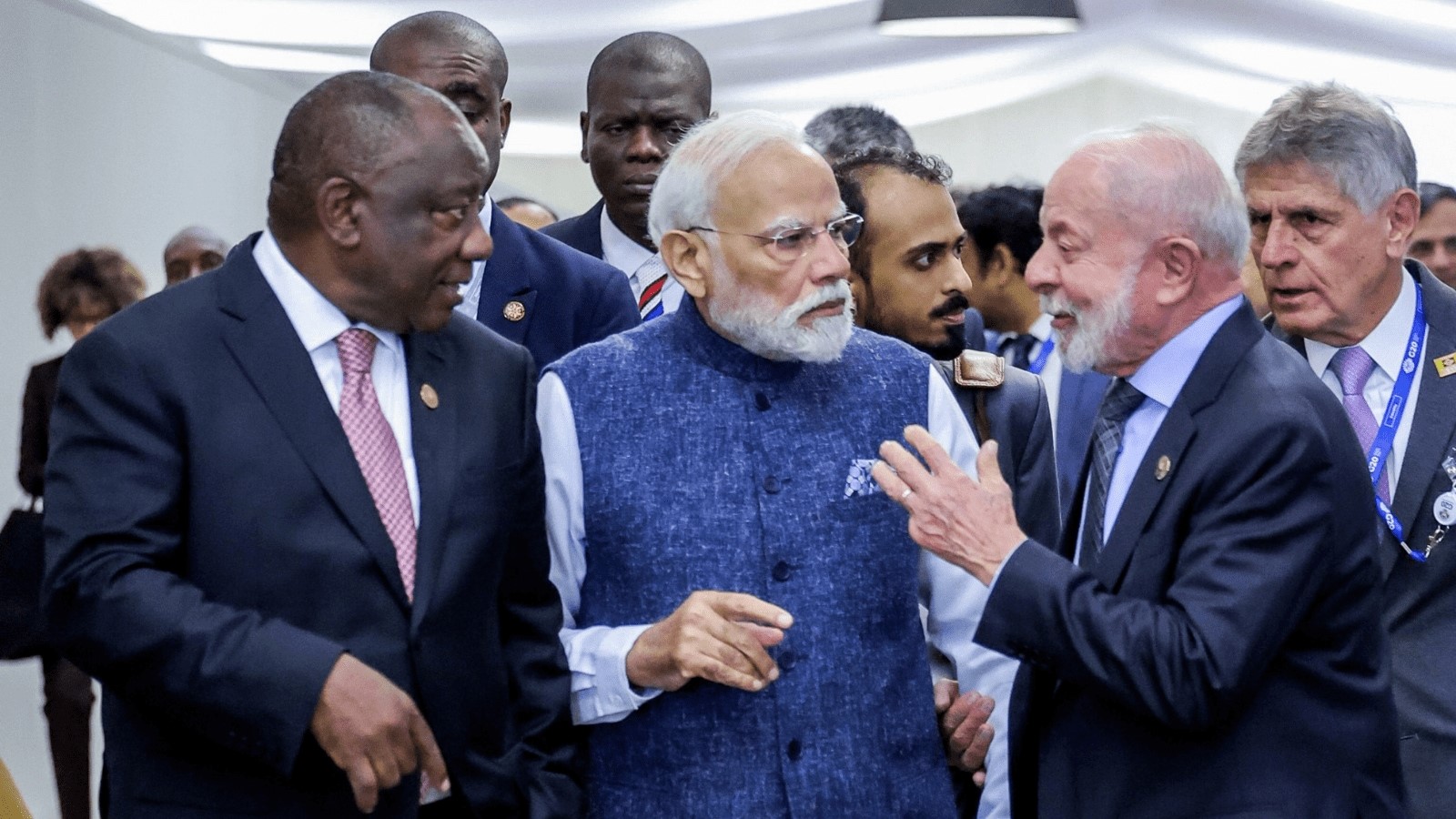
On the sidelines of the G20 Summit in Johannesburg, the leaders of India, Brazil and South Africa reaffirmed the relevance of the IBSA (India–Brazil–South Africa) Dialogue Forum at a time of global fragmentation, geopolitical churn and weakening multilateralism. Prime Minister Narendra Modi’s call for unified action against terrorism, reform of global institutions, and cooperation in climate-resilient agriculture and digital innovation underscored IBSA’s potential as a values-based Global South platform.
What is the IBSA Forum?
IBSA was formalised in 2003 through the Brasilia Declaration as a trilateral grouping of three large democracies from Asia, Africa and South America. It has no permanent secretariat or headquarters, operating through periodic summits, ministerial meetings and working groups.
Three pillars of IBSA cooperation are:
- Political consultation on global and regional issues.
- Trilateral sectoral cooperation through working groups and people-to-people forums.
- Development cooperation via the IBSA Trust Fund, established in 2004 and operational since 2006.
The IBSA Fund has supported around 50 South–South development projects in health, education, women’s empowerment, agriculture and renewable energy across more than 40 developing countries, especially Least Developed Countries (LDCs).
Key Outcomes and Proposals at the 2025 IBSA Meeting
At Johannesburg, India proposed several initiatives to reinvigorate IBSA:
- Unified push against terrorism: Calling for “no double standards,” India proposed institutionalising an NSA-level dialogue for regular security and counter-terrorism coordination.
- UN Security Council Reform: Leaders reiterated that existing global institutions do not reflect contemporary realities. As none of the IBSA countries is a permanent UNSC member, coordinated advocacy for reform was emphasised.
- Climate-Resilient Agriculture Fund: Building on the success of the IBSA Fund, India proposed a dedicated fund to support climate adaptation in agriculture.
- Digital Innovation Alliance: Sharing India’s Digital Public Infrastructure (DPI)-such as UPI, CoWIN, cybersecurity frameworks and women-led digital initiatives with other developing countries.
- Maritime and Defence Cooperation: IBSA’s practical security dimension is reflected in IBSAMAR, the trilateral naval exercise, whose 8th edition was held in 2024 off South Africa.
Strategic Importance of IBSA for India
- Voice of the Global South: IBSA allows India to project leadership without the structural dominance of China, unlike platforms such as BRICS or SCO.
- Advancing UNSC Reform: Collective advocacy by three regional powers strengthens India’s long-standing demand for a permanent UNSC seat.
- Soft Power and Development Diplomacy: The IBSA Fund exemplifies non-coercive, transparent South–South cooperation, enhancing India’s credibility as a development partner.
- Exporting Indian Solutions: DPI cooperation enables India to globalise its governance innovations in payments, health and digital inclusion.
Key Challenges
Despite its promise, IBSA faces several constraints:
- Agenda Overlap with BRICS: Many IBSA priorities UN reform, Global South development, climate action are also pursued within BRICS, which attracts greater political attention.
- Geopolitical Divergence: Variations in foreign policy outlooks, especially Brazil’s and South Africa’s relatively flexible stances towards China, limit strategic convergence.
- Low Economic Integration: Intra-IBSA trade remains modest due to weak logistics and similar economic profiles, creating competition rather than complementarity.
- Institutional Weakness: Absence of a permanent secretariat hampers continuity, monitoring and implementation.
Way Forward
To remain relevant, IBSA must:
- Focus on niche areas such as democratic governance, DPI, climate-resilient development and counter-terrorism.
- Establish a small permanent secretariat and an IBSA Business Council for continuity and economic engagement.
- Use IBSA as a coordinating caucus within BRICS to balance great-power dominance.
- Revitalise the IBSA Fund to showcase tangible outcomes of South–South cooperation.
Conclusion
In an era of geopolitical uncertainty and weakening multilateralism, IBSA offers a values-driven, democratic and inclusive alternative for Global South cooperation. If revitalised with focused agendas and stronger institutions, the forum can amplify India’s strategic influence while promoting equitable growth, global governance reform and human-centric development.