
India's Semiconductor Roadmap: NITI Aayog's 10-Year Vision
- 06 Jun 2026
In News:
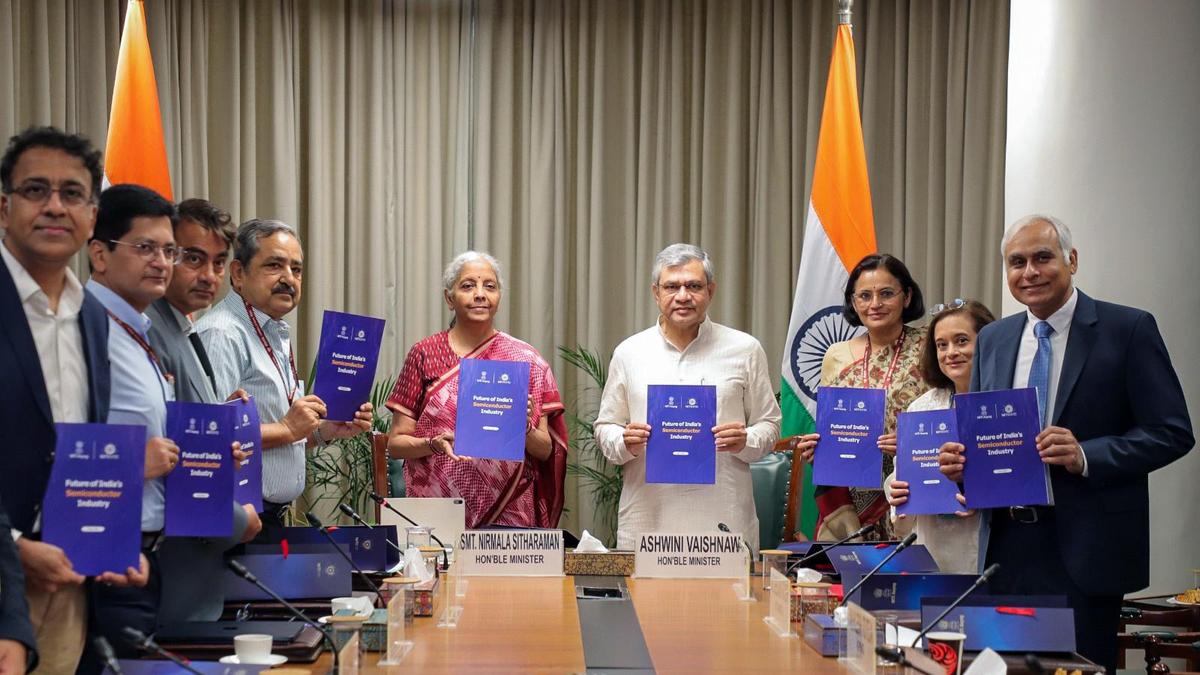
Union Finance Minister Nirmala Sitharaman and IT Minister Ashwini Vaishnaw jointly launched the NITI Aayog Frontier Tech Hub's report titled "Future of India's Semiconductor Industry" — India's first comprehensive 10-year roadmap for the semiconductor sector. The joint launch signals cross-ministerial ownership across Finance, MeitY, and NITI Aayog.
India's Current Status
- India currently does not possess a fully operational semiconductor fabrication plant. The first fab, expected in Dholera, Gujarat, may become operational by 2028. Around 10 semiconductor projects are under various stages of development. India imports nearly all its semiconductor requirements, making the economy vulnerable to global supply chain disruptions.
- The Union government had earlier launched the India Semiconductor Mission (ISM) with a corpus of ?76,000 crore, providing capital subsidies of over 50% for fabrication units, supporting compound semiconductors, packaging facilities, and design-linked incentives for startups.
Key Findings of the Report
- The report explicitly states that India's local ecosystem is not ready to fully meet domestic demand. Many semiconductor components used in defence systems are sourced from outside India, posing national security risks.
- Taiwan dominates global chip manufacturing; a disruption there could massively impact India's electronics supply chain. Fabrication units require 4–5 years before commencing production, and the sector demands "sustained, mission-mode commitment over a decade or more."
Strategic Vision: $120–150 Billion by 2035
- The report presents a strategic blueprint to establish a USD 120–150 billion semiconductor ecosystem by 2035. Rather than competing in the capital-intensive race for cutting-edge wafer fabrication, the roadmap advocates a "More-than-Moore" strategy focused on mature logic nodes, advanced OSAT (Outsourced Semiconductor Assembly and Test) packaging, and specialised wide-bandgap compound materials.
Capital Requirements and ISM 2.0
- The report estimates state capital expenditure of $45–60 billion over a decade for the second phase (ISM 2.0). The roadmap directly reinforces priorities announced under India Semiconductor Mission 2.0 in Union Budget 2026, marking India's shift from ecosystem creation to ecosystem deepening — from attracting investments to developing deeper capabilities across design, materials, manufacturing, packaging, talent, R&D, and trusted global partnerships.
Strategic Focus Areas
- The report steers away from frontier chips (3–7 nanometre nodes) where risks are very high, and instead prioritises mature and advanced nodes, compound semiconductors for defence and industrial applications, and advanced chip packaging as a "core production pillar." Clear goals include positioning India as a leading global destination for advanced packaging and OSAT, building leadership in compound semiconductor manufacturing, and creating more than 100 advanced semiconductor design IPs.
Trusted Partners and Geopolitics
Priority partner nations identified are the United States, Japan, the European Union, and South Korea — for access to critical tools, technology transfer, and joint R&D. The report implicitly treats China as an adversarial player, reflecting the broader global semiconductor realignment away from Chinese supply chains.