
AI-Driven Disaster Resilience: Transforming India’s Management Framework
- 25 Mar 2026
In News:
India’s geographical diversity makes it highly susceptible to a range of natural disasters, from cyclones and floods to avalanches and droughts. In a landmark shift toward technology-led resilience, the Government of India has significantly expanded the role of Artificial Intelligence (AI) and Machine Learning (ML) following the enactment of the Disaster Management (Amendment) Act, 2025. This legislative and technological synergy aims to move the nation from a "reactive" relief-centric approach to a "proactive" predictive-modeling stance.
The Disaster Management Cycle & AI Integration
AI is being integrated across all four stages of the disaster management cycle to enhance precision and reduce human casualty.
A. Preparedness and Early Warning
The India Meteorological Department (IMD) has pioneered the use of AI/ML under Mission Mausam to bridge the gap between data collection and actionable intelligence.
- Seven-Day Forecasts: Advanced ML models now provide 7-day advance weather predictions with higher local accuracy.
- Cyclone Tracking: AI-enhanced satellite imagery analysis allows for better prediction of cyclone intensity and landfall coordinates.
B. Mitigation and Hydrological Modelling
The Central Water Commission (CWC) has deployed AI to tackle India's most frequent disaster: flooding.
- Short-Range Forecasting: AI models process real-time rainfall data and river discharge levels to provide short-range flood alerts.
- Digital Advisories: Real-time flood advisories are disseminated via integrated digital portals, utilizing rainfall-based hydrological modelling to warn downstream populations.
C. Risk Mapping and Decision Support
The National Disaster Management Authority (NDMA) has developed sophisticated tools to assist local administrators.
- Web-DCRA & DSS: The Web-based Dynamic Composite Risk Analysis and Decision Support System (DSS) allows officials to visualize potential impact zones.
- Dynamic Risk Atlases: These atlases use AI to factor in real-time variables like population density and infrastructure strength—to optimize evacuation planning during cyclones.
D. Specialized Hazard Detection: Geo-Intelligence
Specialized agencies are using AI for niche topographical hazards:
- National Remote Sensing Centre (NRSC): Uses AI-processed satellite data to develop Flood Hazard Atlases, identifying regions that are chronically vulnerable.
- DRDO (Defence Research and Development Organisation): Employs AI for Avalanche Forecasting in high-altitude Himalayan regions. These autonomous systems detect remote-sensing-based changes in snowpack stability to predict slides before they occur.
Key Provisions: The Disaster Management (Amendment) Act, 2025
The 2025 Amendment serves as the legal backbone for these technological interventions:
- Data Centralization: It mandates the creation of a National Disaster Database where AI can draw "training data" from historical disasters.
- Statutory Integration of Tech: Explicitly recognizes the role of AI/ML in the official protocols for early warning and risk assessment.
- Private Sector Participation: Encourages partnerships with tech firms for the development of "Disaster-Tech" solutions.
Challenges and Way Forward
While AI offers immense potential, several hurdles remain for India:
- Data Quality: AI is only as good as the data it is trained on; sparse historical data in certain remote regions can lead to "algorithmic bias."
- Last-Mile Connectivity: An AI-generated warning is only effective if it reaches a farmer in a remote village in time.
- Ethics of Automation: Ensuring that human oversight remains central to life-and-death evacuation decisions.
Conclusion
The integration of AI into disaster management represents a paradigm shift in India's governance. By leveraging tools from the IMD, CWC, and DRDO, India is building a "Digital Shield" against natural calamities. For a developing economy, this transition is not merely a technological upgrade but a vital necessity to protect its human capital and economic infrastructure from the increasing volatility of climate change.
The Rise of the Woman Farmer: Towards Gender-Inclusive Agri-Food Systems
- 25 Mar 2026
In News:
The United Nations has officially designated 2026 as the International Year of the Woman Farmer (IYWF). This global recognition highlights the indispensable role women play in maintaining global food security and rural resilience. In India, where agriculture is the backbone of the economy, women are the primary drivers of the sector. Despite being historically categorized as "invisible laborers," a paradigm shift is underway to recognize them as independent entrepreneurs and technological leaders.
To mark this transition, India recently hosted the Global Conference on Women in Agri-Food Systems (GCWAS–2026) in New Delhi, focusing on gender-responsive policies and the economic inclusion of women in the $5 trillion economy vision.
The Indian Context: Statistical Overview
The "feminization of agriculture" in India is reflected in the sheer scale of female participation in the rural workforce:
- Livelihood Dominance: Approximately 80% of all economically active women in rural India are employed in the agricultural sector.
- Workforce Dynamics: Of the rural female workforce, 33% serve as agricultural laborers and 48% are self-employed farmers.
- Financial Inclusion: Since its inception, the PM-KISAN scheme has disbursed over ?1.01 lakh crore to women, who constitute roughly 25% of the total beneficiaries.
- Collectivization: The movement toward formal business structures is gaining momentum, with 1,175 Farmer Producer Organizations (FPOs) currently boasting 100% women shareholders.
Multi-Dimensional Roles and Contributions
Women are involved across the entire agricultural value chain, performing roles that range from traditional labor to high-tech service provision.
1. Crop Production and Livestock Management: Women handle the most labor-intensive pre-harvest tasks, such as sowing, weeding, and paddy transplantation. In the allied sectors, they are the primary managers of dairy, poultry, and small ruminants. The success of the Pashu Sakhi model where women provide doorstep veterinary services has been instrumental in reducing livestock mortality and increasing household income.
2. Post-Harvest Value Addition: Through Self-Help Groups (SHGs), women lead the transformation of raw produce into marketable goods. Activities like spice grinding, mushroom cultivation, and honey processing under the National Beekeeping and Honey Mission (NBHM) have significantly increased the shelf life and profitability of farm output.
3. Technological Adoption: The Namo Drone Didi Scheme is a flagship initiative providing 15,000 drones to women SHGs. This empowers them to provide high-tech services like precision liquid fertilizer and pesticide application, moving them away from manual drudgery toward skilled, service-based livelihoods.
Major Government Initiatives and Institutional Support
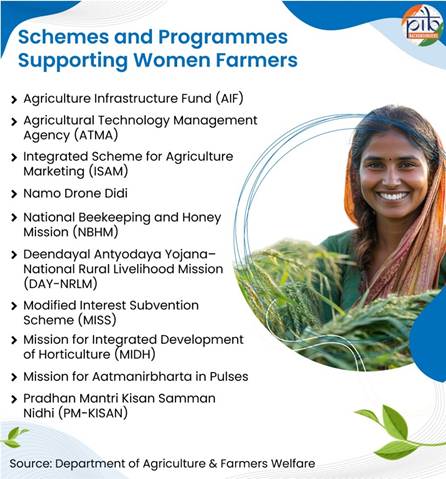
A robust framework of schemes and institutions supports the economic and social empowerment of women farmers:
- Mahila Kisan Sashaktikaran Pariyojana (MKSP): A sub-component of DAY-NRLM, it has supported over 4.62 crore Mahila Kisans in adopting agro-ecological practices and sustainable livestock management.
- Agriculture Infrastructure Fund (AIF): Provides debt financing with a 3% interest subvention for women-led projects to develop post-harvest facilities like cold storage and warehouses.
- Krishi Sakhi Programme: A dedicated cadre of 70,000 women para-extension workers is being trained to provide doorstep guidance on natural farming and soil health, bridging the "lab-to-land" gap.
- ICAR-Central Institute for Women in Agriculture (CIWA): Located in Bhubaneswar, this institute conducts specialized research to develop drudgery-reducing tools (like pedal-operated coconut dehuskers and maize shellers) tailored for female ergonomics.
- Modified Interest Subvention Scheme (MISS): Ensures affordable credit through Kisan Credit Cards (KCC), with the collateral-free limit increased to ?2 lakh as of 2025 to assist women who lack land titles.
Critical Challenges and Barriers
Despite their significant contributions, women farmers face systemic hurdles that hinder their full potential:
- Land Ownership and Invisibility: A majority of women do not hold formal land titles. This lack of "legal recognition" makes it difficult for them to register for government portals like PM-KISAN or access institutional bank loans that require collateral.
- Technological Mismatch: Most agricultural machinery is traditionally designed for men. The high physical drudgery associated with traditional tools continues to cause significant musculoskeletal strain.
- Knowledge and Information Gap: Agricultural extension services have traditionally targeted male heads of households. Technical training on high-yield variety (HYV) seeds or modern pesticides often fails to reach the women who are the actual implementers in the fields.
- Climate Vulnerability: Women have fewer resources to adapt to sudden climate shocks. During periods of drought, the added burden of walking longer distances for water and fodder leaves them with less time for productive farm management.
The Roadmap for IYWF 2026 and Beyond
To move from subsistence to sustainability, the following strategic interventions are necessary:
- Digital Verification of Land: Speeding up the digital linking of land records to ensure more women can self-register for Direct Benefit Transfer (DBT) schemes.
- Scaling Women-Led FPOs: Reaching the target of 10,000 FPOs with a focus on states like Odisha, Bihar, and Jharkhand, where women-led collectives are already thriving.
- Gender-Sensitive Mechanization: Expanding the scope of Farm Machinery Training and Testing Institutes (FMTTIs) to specifically train women in operating and repairing small-scale, ergonomic machinery.
- Mainstreaming Krishi Sakhis: Institutionalizing these para-professionals as the formal link between the government’s technical departments and the rural farming community.
Conclusion
The empowerment of women farmers is not just a matter of social equity but a prerequisite for India’s food security and the achievement of a $5 trillion economy. By transforming women from laborers to entrepreneurs through schemes like Namo Drone Didi and the Dalhan Aatmanirbharta Mission, India can lead the global narrative during the International Year of the Woman Farmer 2026. Strengthening women’s leadership in agriculture will ultimately create a more resilient, inclusive, and climate-smart agri-food system for the future.