
India-Sweden Strategic Partnership
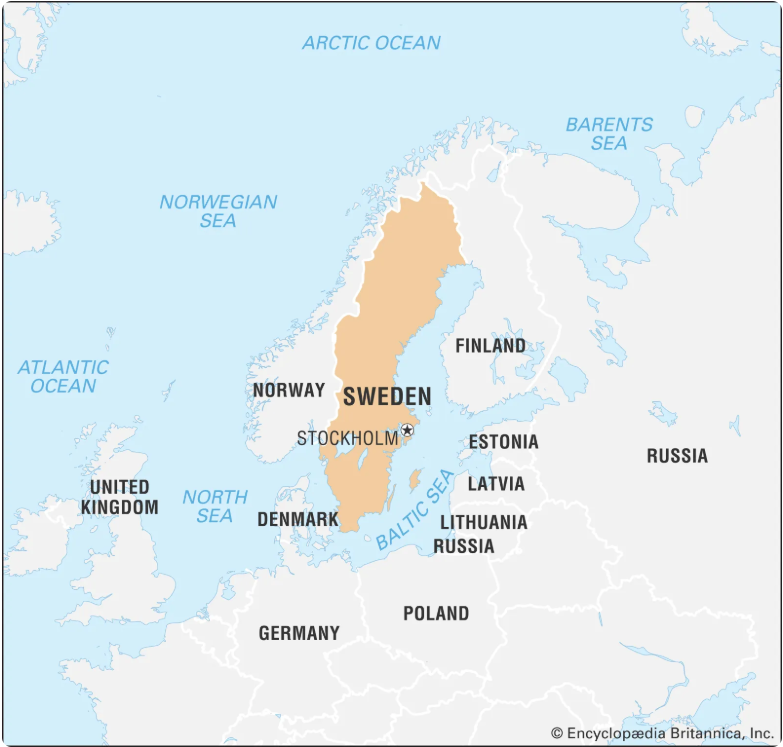
- 22 May 2026
In News:
Prime Minister Narendra Modi held bilateral consultations with Swedish Prime Minister Ulf Kristersson in Gothenburg, Sweden, where the two leaders agreed to elevate India-Sweden ties to the level of a Strategic Partnership, operationalised through the India-Sweden Joint Action Plan 2026–2030. PM Modi was also conferred with the Royal Order of the Polar Star (Commander Grand Cross) — one of Sweden's highest state honours — during the visit.
Four Pillars of the Strategic Partnership
The Strategic Partnership is guided by four pillars: Strategic Dialogue for Stability and Security; Next-Generation Economic Partnership; Emerging Technologies and Trusted Connectivity; and Shaping Tomorrow Together — People, Planet, Health and Resilience.
- Pillar 1 (Security): Both nations agreed to strengthen counter-terrorism cooperation through the India-EU Joint Working Group on Counter-Terrorism and deepen parliamentary exchanges through the newly formed India-Nordic Parliamentary Friendship Group in the Lok Sabha and the Friendship Group for India in the Swedish Riksdag.
- Pillar 2 (Economy): India and Sweden committed to doubling bilateral trade within five years, with a Bilateral Trade and Investment Summit planned for 2027 themed "India-Sweden: Stronger Together – towards 2047." The partnership will promote "Make in India" and "Made with Sweden" co-production, alongside IPR cooperation, green ports, airports, direct air connectivity, and a bilateral SME and start-up platform.
- Pillar 3 (Technology): Both sides agreed to connect their AI ecosystems through the Sweden-India Technology and Artificial Intelligence Corridor (SITAC) and established the India-Sweden Joint Science and Technology Centre (ISJSTC). Priority areas include AI, 6G, quantum computing, critical minerals, sustainable transport, renewable energy, smart cities, and circular economy — the full spectrum of Industry 4.0/5.0 technologies.
- Pillar 4 (People and Planet): Both nations agreed to launch LeadIT 3.0 — a new four-year phase of the Leadership Group for Industry Transition — at COP31 in Antalya, Turkey (November 2026), furthering heavy industry decarbonisation. Cooperation under the International Solar Alliance (ISA) and Mission LiFE was also reaffirmed. The year 2026 will be commemorated as the centenary of Rabindranath Tagore's visit to Sweden through the "Tagore-Sweden Lecture Series."
Bilateral Relations: Key Facts
The leaders underscored that the recently concluded India-EU FTA has opened a new chapter in economic and commercial ties. Bilateral goods trade has grown from USD 2.86 billion (2016) to USD 6.96 billion (2024), making India Sweden's third-largest trading partner in Asia. Sweden's cumulative FDI into India stands at USD 2.596 billion (April 2000–December 2024). Swedish defence major SAAB has begun constructing a 100% FDI manufacturing plant in Haryana for Carl Gustaf Mark IV shoulder-fired weapons. On the space front, Sweden's IRF is providing the Venusian Neutrals Analyser (VNA) for ISRO's upcoming Shukrayaan-1 (Venus Orbiter Mission).
Challenges
Key structural challenges include Sweden's NATO membership versus India's strategic autonomy (limiting deep defence integration), complex IP-transfer negotiations in sensitive technology domains, non-tariff barriers and the EU's Carbon Border Adjustment Mechanism (CBAM) affecting Indian exports, and both nations' shared vulnerability to China's dominance in critical mineral processing — essential for AI, EVs, and space technology.
Way Forward
- Anchor within the EU: Sweden should serve as India's strategic bridge within the EU for smooth India-EU FTA implementation, with a joint working group helping Indian MSMEs navigate CBAM and non-tariff barriers.
- Operationalise SITAC: A dedicated IP protection protocol must provide legal certainty for SITAC-based joint ventures in quantum computing, 6G, and AI — converting corridor-level intent into enforceable co-development agreements.
- Blended Finance for Green Transition: Pooling multilateral climate funds, Swedish sovereign investment, and Indian public capital can bridge the cost gap for high-end green technology transfer, making LeadIT 3.0 commercially viable rather than aspirational.
- Critical Minerals: Both nations must jointly develop mid-stream processing capabilities — bilaterally or through the broader India-Nordic framework — to reduce shared dependence on China for rare earths critical to AI, EVs, and space technology.
- Defence Co-Production: The relationship must evolve from procurement to structured joint R&D within India's Defence Industrial Corridors. Simplifying offset clauses and ensuring regulatory predictability will incentivise Swedish OEMs to deepen manufacturing integration.
- Totalization Agreement: Expediting a Social Security Totalization Agreement will eliminate dual pension contributions, directly enabling the seamless talent and researcher mobility envisioned under the Joint Action Plan.
Conclusion
The India-Sweden Strategic Partnership reflects a decisive evolution from transactional trade toward a deep-tech alliance combining Swedish innovation with India's manufacturing scale and digital dynamism. Arriving at a moment of global supply chain fragmentation and technology bloc formation, this partnership — anchored in shared democratic values and institutionalised through the Joint Action Plan 2026–2030 — offers India a critical technology co-creator and green transition partner within Europe. Converting the strategic goodwill of Gothenburg into tangible outcomes across AI, clean energy, defence co-production, and critical minerals will ultimately determine whether this partnership becomes a model for India's engagement with the democratic world in the Viksit Bharat era.