
India’s Four Labour Codes
- 25 Nov 2025
In News:
India has operationalised the four Labour Codes, the Code on Wages (2019), Industrial Relations Code (2020), Code on Social Security (2020), and Occupational Safety, Health and Working Conditions (OSH) Code (2020) replacing 29 central labour laws.
Enacted on the recommendations of the Second National Commission on Labour (2002), these reforms aim to modernise labour regulation, simplify compliance, extend social security, and align India’s workforce framework with the needs of a dynamic economy and Aatmanirbhar Bharat.
Key Provisions of the Four Labour Codes
1. Code on Wages, 2019
- Universal Coverage: Applies to all employees across sectors, wages, and gender (including transgender persons).
- National Floor Wage: Sets a statutory baseline; States cannot fix wages below it.
- Uniform Wage Definition: Wage includes basic pay, dearness allowance, and retaining allowance; minimum 50% of total remuneration for social security calculations.
- Working Hours & Overtime: Capped at 8 hours/day, 48 hours/week; overtime at twice the normal wage.
- Timely Payment & Documentation: Strict timelines for wage payment; mandatory wage slips (physical/electronic).
- Deductions: Not to exceed 50% of total pay.
2. Code on Social Security, 2020
- Expanded Coverage: Integrates nine laws and extends benefits to organised, unorganised, gig, and platform workers—defined for the first time.
- Social Security Fund: For unorganised, gig, and platform workers; funded by Centre/States, CSR, and aggregator contributions (1–2% of turnover; capped).
- Parity for Fixed-Term Employees: Eligible for gratuity after one year (earlier five years for permanents).
- Wider ESIC & EPF Reach: Nationwide ESIC; mandatory even for a single worker in hazardous occupations; EPF to establishments with 20+ workers irrespective of industry.
- Administrative Reforms: Inspector-cum-facilitators; web-based inspections; time-bound EPF inquiries.
- Worker-Centric Additions: Accidents during commute treated as employment-related; expanded family definition for female employees.
3. Industrial Relations Code, 2020
- Consolidation: Merges laws on trade unions, standing orders, and industrial disputes.
- Fixed-Term Employment (FTE): Permitted with equal benefits; intended for seasonal/short-tenure needs.
- Thresholds: Prior government approval for layoff/retrenchment/closure raised from 100 to 300 workers.
- Strikes & Disputes: Notice requirement extended to all establishments; expanded definition of strike (includes mass casual leave).
- Collective Bargaining: Sole negotiating union with 51% membership; otherwise, a negotiating council with proportional representation.
4. Occupational Safety, Health and Working Conditions (OSH) Code, 2020
- Consolidation: Integrates 13 laws (Factories, Mines, Plantations, etc.).
- Simplified Compliance: Single registration, common licences, electronic filings; higher thresholds for factory licensing.
- Contract Labour: Threshold raised to 50 workers; conditional use in core activities permitted.
- Women’s Participation: Night work allowed with consent and safety safeguards.
- Migrant Workers: Expanded definition; portability of PDS and social security; annual travel allowance.
- Workplace Safety: Mandatory appointment letters; free annual health check-ups; safety committees for large establishments.
Rationale for Reform
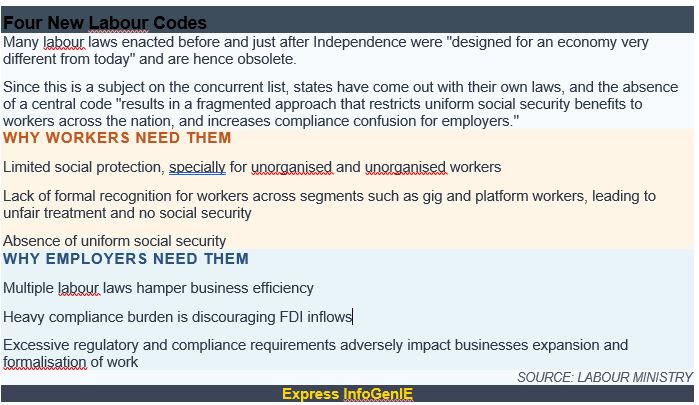
- Fragmentation & Obsolescence: Multiple, overlapping laws unsuited to modern industry and new forms of work.
- High Compliance Costs: Burdensome licensing and reporting, especially for MSMEs.
- Coverage Gaps: Informal and gig workers largely excluded earlier.
- Global Competitiveness: Need for predictable, transparent labour regulation to attract investment.
- Formalisation & Employment: Simplified rules to encourage job creation and transition to formal work.
Key Concerns and Critiques
- MSME Compliance Load: Expanded ESIC/EPF and safety norms may raise costs and require digital capacity.
- Federal Coordination: Labour is on the Concurrent List; divergent State rules risk uneven protections.
- Industrial Relations: Higher thresholds and strike regulations may dilute worker bargaining power; 51% rule may marginalise smaller unions.
- Job Security: Potential overuse of FTE could increase precarity; litigation risk over disguised permanency.
- Awareness Gap: Informal and migrant workers may not fully access new entitlements during transition.
Constitutional Context
- Preamble Values: Justice, equality, dignity guide labour law interpretation.
- Fundamental Rights:
- Articles 14–18: Equality and non-discrimination.
- Articles 19–22: Freedom of association (trade unions).
- Articles 23–24: Prohibition of forced and child labour.
- Article 21: Right to dignified working conditions.
- Judicial Precedents: Bandhua Mukti Morcha, PUDR, Neerja Chaudhary expanded labour rights and rehabilitation.
Way Forward
- Uniform Implementation: Model rules or an intergovernmental labour council to harmonise State regulations.
- Safeguards on FTE: Clear limits, audits, and grievance redress to prevent misuse.
- Gig Worker Security: A dedicated national policy with enforceable aggregator contributions.
- MSME Support: Digital helpdesks, simplified filings, and transitional fiscal support.
- Capacity Building: Worker awareness drives and institutional strengthening for inspectors-facilitators.
Conclusion
The four Labour Codes mark a structural shift toward a simpler, inclusive, and future-ready labour ecosystem balancing worker welfare with business efficiency. Their success hinges on cooperative federalism, robust safeguards against misuse, and effective on-ground implementation to ensure that growth and dignity at work advance together.