
16th Finance Commission (2026–31)
- 28 Feb 2026
In News:
The 16th Finance Commission (FC), chaired by Dr. Arvind Panagariya, submitted its report for the period 2026–27 to 2030–31, which was tabled in Parliament on February 1, 2026. As a constitutional body under Article 280, the Finance Commission recommends the distribution of tax revenues between the Centre and the States and provides grants to local governments. The latest recommendations reflect continuity in vertical devolution while significantly enhancing support for urban local bodies amid India’s accelerating urbanisation.
Vertical Devolution: Share of States
The Commission has recommended that 41% of the divisible pool of central taxes be devolved to states, maintaining the level set by the 15th Finance Commission.
The divisible pool excludes:
- Cost of tax collection
- Revenues from cesses and surcharges
By retaining the 41% share, the Commission balances fiscal consolidation needs of the Centre with states’ expenditure responsibilities.
Horizontal Devolution: Criteria Among States
The 16th FC revised the weightage assigned to various criteria for distributing tax shares among states:
- Income Distance: 42.5% (reduced from 45%)
- Population (2011 Census): 17.5% (increased from 15%)
- Demographic Performance: 10% (reduced from 12.5%)
- Area: 10% (reduced from 15%)
- Forest Cover: 10% (unchanged)
- Contribution to GDP: 10% (newly introduced)
- Tax and Fiscal Effort: Removed (earlier 2.5%)
The introduction of GDP contribution marks a shift toward recognising economic productivity, while still preserving redistributive principles through income distance.
Major Boost to Urban Local Governments
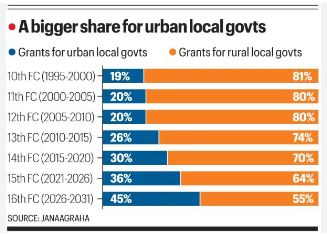
A significant highlight of the report is enhanced financial backing to Urban Local Bodies (ULBs).
- Share of grants to urban local governments increased to 45%
- (Up from 36% under the 15th FC and 26% under the 13th FC)
- Recommended allocation: ?3.56 lakh crore
- More than double the 15th FC’s ?1.55 lakh crore
- Nearly 15 times the post-2011 Census allocation under the 13th FC
Since the 10th FC, grants to local bodies have been a regular feature following the 73rd and 74th Constitutional Amendments. The 16th FC’s enhanced allocation reflects recognition of growing urban governance demands.
Uneven State-Level Outcomes
Due to the population-based distribution formula, states witnessed varied increases:
- Kerala: Over 400% increase
- Maharashtra: Over 300% increase
- Odisha: 13% increase
- Bihar: 8% reduction
These variations underscore ongoing tensions in balancing demographic realities and fiscal equity.
Urbanisation and Policy Imperatives
India’s urban population is projected to reach 41% by 2031. The 2011 Census recorded urbanisation at 31%, though alternative estimates (e.g., World Bank, 2015) suggest much higher levels. Data discrepancies complicate planning and fiscal projections.
The 16th FC’s higher allocation acts as a financial cushion against potential upward revisions in urbanisation in Census 2027. If urbanisation rises to, say, 48%, the enhanced funding framework would prevent under-preparedness in urban infrastructure and service delivery.
Conclusion
The 16th Finance Commission reinforces fiscal federalism by maintaining stable vertical devolution while recalibrating horizontal distribution criteria. Its substantial increase in grants to urban local governments signals recognition of India’s structural urban transition. However, uneven state allocations and persistent data gaps highlight the complexity of aligning demographic change with fiscal design. The recommendations represent a calibrated approach toward strengthening both cooperative federalism and grassroots governance in a rapidly urbanising economy.