
Strategic Reform of India’s Fertilizer Policy
- 14 Apr 2026
In News:
The recent volatility in West Asia has exposed a critical vulnerability in India’s agricultural sector: a staggering 70% import dependency for chemical fertilizers and their feedstocks. With global urea prices surging by 65% (from $482 to $795 per tonne) in just 40 days during the 2026 conflict, the need for a comprehensive overhaul of the fertilizer regime has become a matter of national sovereignty and economic stability.
The Current Landscape: Data and Statistics
India’s maritime and land-based supply chains are highly sensitive to geopolitical shifts in the Strait of Hormuz and the Black Sea region.
- Consumption vs. Production: India consumes 40 million tonnes (MT) of urea annually. While 30 MT is produced domestically, 85% of the natural gas required for this production is imported. The remaining 10 MT of urea is imported directly.
- The Efficiency Gap: Traditional granular urea has a Nutrient Use Efficiency (NUE) of only 35-40%, meaning over 60% of the fertilizer is lost to the atmosphere as greenhouse gases or leached into groundwater.
- Environmental Cost: Excess nitrogen application releases nitrous oxide, a greenhouse gas 273 times more potent than carbon dioxide.
India's Existing Policy Framework
To protect farmers from global price shocks, the government currently employs several mechanisms:
- Urea Subsidy: The government mandates a fixed Maximum Retail Price (MRP) for urea (currently <$70/tonne). The difference between the production cost and this MRP is paid as a subsidy to manufacturers.
- Nutrient Based Subsidy (NBS): For Phosphatic (P) and Potassic (K) fertilizers, a fixed subsidy is determined based on nutrient content, while MRPs are partially deregulated.
- Neem Coating: 100% of urea is coated with neem oil to slow nitrogen release and prevent illegal diversion to the chemical and plywood industries.
- DBT in Fertilizers: Subsidies are released to companies only after a sale is verified via Point of Sale (PoS) machines using biometric authentication.
Core Challenges and Policy Distortions
Despite these measures, the system faces deep-seated structural issues:
- Massive Price Arbitrage: The gap between the domestic price ($70/tonne) and the global price ($795/tonne) creates an irresistible incentive for smuggling to neighboring countries and industrial diversion.
- Nutrient Imbalance: Because urea is exceptionally cheap, farmers often use double the recommended amount. This skews the N-P-K ratio, leading to soil degradation and "dead" soil biology.
- Fiscal Burden: Rising Liquefied Natural Gas (LNG) and Di-ammonium Phosphate (DAP) prices on the global market create an unsustainably high subsidy bill for the Union Budget.
- Exclusion of Tenants: Since the current system relies on land records for some verifications, tenant farmers—who perform the actual cultivation—often struggle to access subsidized inputs.
Strategic Roadmap for Reform
To transition toward a more resilient and efficient system, experts suggest a multi-pronged approach:
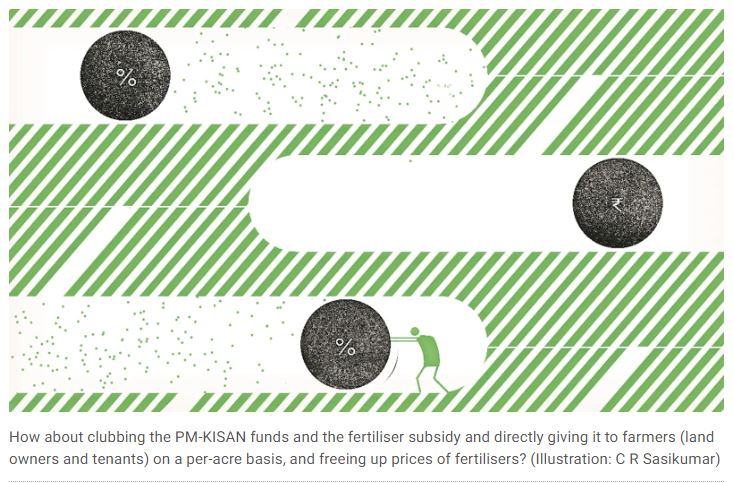
1. Transition to Direct Cash Transfers: Instead of subsidizing the product, the government should provide a per-acre direct payment to farmers. This can be achieved by merging PM-KISAN funds with fertilizer subsidies, ensuring both landowners and actual tenants receive support.
2. Quantitative Rationing and Liberalization
- Rationing: Implement a 10-15% supply cut to states, requiring allocation based on specific crop types and land records to prevent over-application.
- Price Liberalization: Once direct cash transfers are established, the market price of fertilizers should be freed. High market prices naturally incentivize efficient usage.
3. Technological and Product Innovation
- Liquid Nano Urea: Shift focus toward liquid fertilizers which offer a 90% NUE via fertigation, significantly reducing waste and the carbon footprint.
- Alternative Nutrients: Incentivize Triple Super Phosphate (TSP) over DAP. TSP saves 18% nitrogen content per bag, helping to reduce the overall urea subsidy bill.