
Bishkek Declaration 2026: SCO’s Evolving Security and Strategic Role
- 03 Sep 2026
In News:
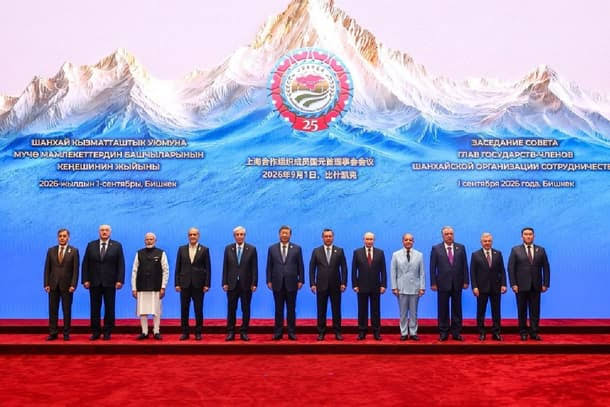
The 26th Meeting of the Council of Heads of State of the Shanghai Cooperation Organisation (SCO) was held in Bishkek, Kyrgyzstan, marking the organisation’s 25th anniversary. The summit adopted the Bishkek Declaration, along with several other decisions and statements.
Key Outcomes of the Bishkek Declaration
1. Counter-terrorism and regional security
- The SCO strongly condemned terrorism in all its forms and manifestations and rejected double standards in combating terrorism.
- Members emphasised action against terrorism, separatism and extremism, along with transnational organised crime and drug trafficking.
- The declaration called for combating the cross-border movement of terrorists through implementation of relevant UN Security Council resolutions and the UN Global Counter-Terrorism Strategy.
- Cyber and information security received greater attention, reflecting the expanding nature of non-traditional security threats.
Chinese President Xi Jinping also called for security to remain a key SCO priority, including cooperation against terrorism, organised crime, drug trafficking and telecom fraud, as well as in nuclear, information, biological and outer-space security.
2. West Asia and peaceful conflict resolution
The summit expressed concern over instability in West Asia and supported the sovereignty and territorial integrity of Iran. It favoureddialogue, diplomacy and de-escalation as mechanisms for resolving conflicts.
Prime Minister Narendra Modi highlighted that conflicts increasingly have cross-border economic consequences, affecting energy security, maritime trade and global supply chains. He reiterated India's position that conflicts should be resolved through dialogue and diplomacy rather than military confrontation.
3. Connectivity and sovereignty
India supported enhanced connectivity to facilitate trade and integrate markets, while stressing that connectivity projects must respect sovereignty and territorial integrity.
This has particular relevance for India's access to Central Asia through Iran, given the absence of direct overland transit through Pakistan. India also emphasised smoother customs procedures, digital documentation and efficient logistics networks.
India and the SCO: From Security to Opportunities
India articulated its “S-C-O” vision — Security, Connectivity and Opportunity. It advocated transforming the SCO from a primarily security-oriented platform into one delivering tangible developmental outcomes.
India has promoted initiatives such as the SCO Start-up Forum, Young Authors' Conclave and Young Scientists' Forum. The first session of the SCO Civilizational Dialogue Forum, proposed by India, is also scheduled to be held in India.
Significance for India
- Provides a platform to engage simultaneously with China, Russia, Central Asia, Iran and Pakistan.
- Strengthens India's advocacy against cross-border terrorism and terror financing.
- Supports India's Central Asian outreach and connectivity objectives.
- Offers opportunities for cooperation in energy, technology, digital security, trade and counter-terrorism.
- Enables India to advance strategic autonomy and multilateral diplomacy.
Challenges
The SCO remains a diverse grouping with divergent strategic interests, particularly among India, China and Pakistan. Consensus-based decision-making can therefore limit substantive outcomes. Moreover, geopolitical rivalries and competing connectivity initiatives can constrain economic integration.
Way Forward
The SCO needs to move from declarations towards institutionalised cooperation, particularly in counter-terrorism, cyber security, connectivity, energy security and disaster management. Greater coordination with the UN framework, respect for sovereignty and stronger people-to-people and economic linkages can help convert the SCO's large geographical and demographic footprint into practical regional cooperation.