
Sand and Sustainability: An Essential Resource for Nature and Development
- 16 May 2026
In News:
The United Nations Environment Programme (UNEP) released a landmark global report titled Sand and Sustainability: An Essential Resource for Nature and Development. The report highlights a critical environmental blind spot: sand is the most extracted solid material on Earth, second only to water in terms of global consumption volume.
Global Aggregates Market: Key Data and Trends
Surging Global Demand
- Global consumption of sand and gravel has expanded significantly, reaching 50 billion tonnes annually. This marks a fivefold increase from 9.6 billion tonnes, growing at an average annual rate of 3.2%. The global sand market is valued at $569.4 billion, driven by expanding infrastructure.
The Footprint of Urban Expansion
This extraction is directly tied to demographic and spatial shifts:
- Per Capita Spatial Footprint: The average built-up area per person globally grew from 43 square meters to 63 square meters.
- Urban Concentration: Over 45% of the global population resides in urban centers, requiring vast amounts of concrete, glass, and asphalt.
- Demographic Needs: A global population of 8.2 billion requires continuous construction of housing, medical facilities, and transportation networks, doubling the demand for built-up space in developing nations.
Livelihood Dependencies
- Beyond infrastructure, sandy ecosystems provide critical baseline economic services. Approximately 2.3 billion people globally depend on small-scale coastal and riverine fisheries that rely directly on healthy, undisturbed sandy habitats.
Key Factors Driving Global Extraction
Large-Scale Infrastructure and Land Reclamation
- National infrastructure initiatives—such as India's Pradhan Mantri Awas Yojana and nationwide highway expansions—maintain continuous pressure on local riverbed aggregates. Globally, large-scale land reclamation projects, such as those in Manila Bay and the Maldives, require the dredging of millions of cubic meters of marine sand.
The Paradox of Climate Change Adaptation
- Ironically, sand is being heavily extracted to build defensive infrastructure against the consequences of climate change. For example, the Gulhifalhu project in the Maldives dredged 24.5 million cubic meters of sand to raise islands and construct sea walls, illustrating how adaptation measures can worsen environmental degradation at extraction sites.
Advanced Technology Feedstocks
- The expansion of high-tech industries has created a specialized market for high-purity silica sand. Global data centers, semiconductor manufacturing, and utility-scale solar photovoltaic farms depend on high-grade silicon derived from specialized sand mining operations.
Multi-Dimensional Ecological Impacts
Excessive sand mining disrupts the equilibrium of riverine, coastal, and marine ecosystems, leading to several interconnected environmental consequences:
A. Riverine Degradation and Morphological Shifts
Excessive extraction triggers channel bed degradation (lowering of the riverbed). This undermines the structural stability of riverbanks, threatening public infrastructure like bridges and embankments. In India's Chambal River, deep channel carving has altered natural hydrodynamic flows, reducing the landscape's ability to absorb sudden volume shocks and making downstream regions more vulnerable to flash floods.
B. Hydrological Disruption and Groundwater Depletion
In river systems, sand layers function as a natural sponge that retains water and recharges surrounding aquifers. Stripping this sand causes a rapid drop in the local water table. In rural India, domestic hand pumps and agricultural tube wells frequently go dry adjacent to intensive riverbed mining zones.
C. Coastal Degradation and Saline Water Intrusion
Removing protective sand dunes and beach aggregates allows high-salinity seawater to penetrate coastal freshwater tables. In coastal areas of the Philippines, local drinking water aquifers have experienced severe saline intrusion, leaving groundwater unfit for human consumption or agricultural irrigation.
D. Marine Biodiversity Loss
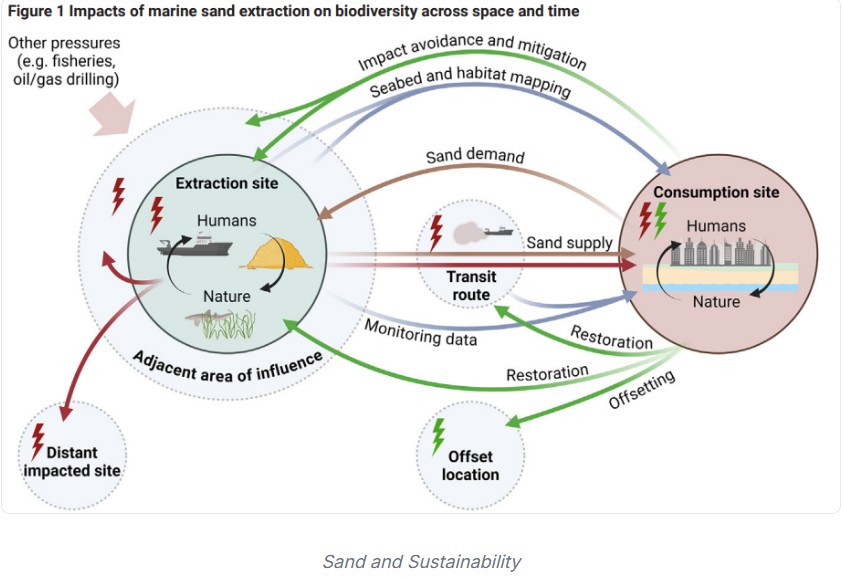
Industrial marine dredging destroys benthic (bottom-dwelling) ecosystems by scraping away habitats and generating massive sediment plumes. These plumes block sunlight, choking coral reefs and killing vital microorganisms and crustaceans. Notably, half of all global marine dredging companies operate within Marine Protected Areas (MPAs), causing severe habitat fragmentation.
E. Public Health Risks
The extraction and processing of silica-rich sand expose workers to fine respirable dust, leading to Silicosis, an irreversible and fatal lung disease. At the extraction sites, abandoned, water-filled mining pits create stagnant pools that serve as vector breeding grounds, increasing the local incidence of water-borne diseases and Malaria.
Regulatory Frameworks and Institutional Responses
Global Level Initiatives
- UNEP 10-Point Action Plan: A global policy blueprint aimed at establishing international standards for sand extraction, defining legal extraction limits, and transition incentives toward circular economy alternatives.
- Marine Sand Watch: A digital tracking platform developed by the United Nations that utilizes Automated Identification System (AIS) data to monitor, identify, and track large-scale dredging vessels operating across the world’s oceans.
India's Domestic Regulatory Framework
- Sustainable Sand Mining Management Guidelines (2016): Mandates the preparation of District Survey Reports (DSR) to scientifically monitor and assess riverbed replenishment rates before any commercial mining leases are granted.
- Enforcement & Monitoring Guidelines (2020): Introduces technology-led oversight, including remote sensing, drone surveillance, and IT-enabled tracking systems (such as QR-coded transit passes) to curb illegal sand mining operations.
- Judicial Oversight via the National Green Tribunal (NGT): The NGT maintains active judicial intervention, enforcing strict bans on riverbed mining conducted without valid environmental clearances (EC) or in violation of sustainable replenishment levels.
Way Forward: Recommendations for Sustainable Resource Management
To prevent ecologic collapse while supporting necessary development, global resource governance must shift toward a circular model:
- Granting Strategic Resource Status: Governments must transition from treating sand as an infinite commodity to designating it as a Strategic Resource, subjecting it to strict sovereign accounting and conservation protocols.
- Promoting Manufactured Sand (M-Sand): Scale up the production of M-Sand (produced by crushing hard granite stones) and eco-aggregates derived from recycled construction and demolition (C&D) waste to substitute for natural riverbed sand.
- Institutionalizing Cumulative Impact Assessments (CIA): Transition away from isolated project clearances. Regulatory bodies must mandate comprehensive CIAs that evaluate the long-term impact of multiple extraction leases on an entire river basin or coastal stretch.
- Enforcing Strict No-Go Zones: Establish absolute statutory bans on sand extraction inside ecologically sensitive areas, including Marine Protected Areas (MPAs), critical wildlife habitats, and vulnerable river reaches.
- Fostering Transboundary Cooperation: Establish international rivers and oceans treaties to manage shared sand resources across international waters and shared river basins, preventing cross-border ecological degradation.
Conclusion
The UNEP report serves as a stark reminder that modern infrastructure relies on a finite resource being extracted at an unsustainable rate. Continued unmitigated extraction risks destabilizing the natural systems that protect coastal and riverine areas from climate change impacts. True long-term economic security requires moving away from linear extraction and adopting a circular model that prioritizes alternative aggregates like M-Sand and recycled materials