
India's Space Sector Transformation
- 24 Jun 2026
In News:
The Press Information Bureau (PIB) released a comprehensive report highlighting India's transformation into a leading global space power over the past twelve years. Anchored in the vision of Aatmanirbhar Bharat and Viksit Bharat 2047, India’s space programme has evolved from a government-driven scientific initiative into a dynamic ecosystem integrating strategic security, commercial innovation, citizen welfare, and international cooperation.
India’s Evolving Space Architecture
India's space sector has transitioned from a closed, state-centric model to an integrated public-private ecosystem. Beyond scientific exploration, space technology today supports governance, agriculture, disaster management, navigation, communication, climate monitoring, and economic growth.
Institutional reforms have encouraged private participation while maintaining ISRO’s leadership in strategic and frontier technologies, thereby strengthening India's position in the global space economy.
Major Achievements
India's commercial space sector has witnessed remarkable expansion in recent years. NewSpace India Limited (NSIL), the commercial arm of ISRO, increased its revenues from ?321.77 crore in FY 2021–22 to ?3,246.09 crore in FY 2024–25, reflecting nearly a tenfold rise. The domestic space startup ecosystem has grown from a single registered startup in 2014 to over 400 startups by February 2026, attracting private investments exceeding USD 500 million.
India has also emerged as a reliable launch service provider, successfully launching 399 foreign satellites between 2014 and March 2026, compared to only 35 launches before 2014. Further, Aditya-L1, India's first solar observatory, has already released over 27 terabytes of scientific data, contributing significantly to global solar research.
Institutional and Policy Reforms
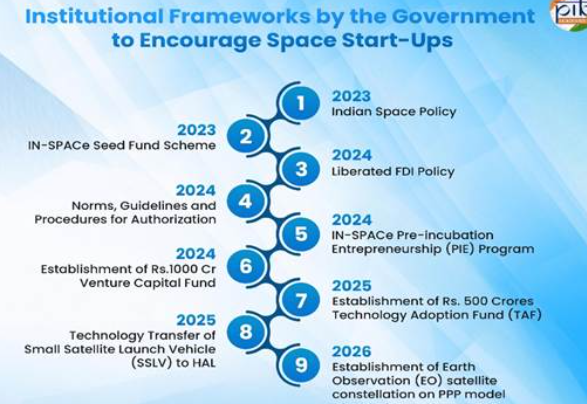
The transformation has been supported by significant policy reforms aimed at liberalising the sector.
The Indian Space Policy, 2023 formally opened satellite manufacturing, launch services, downstream applications, and space-based services to private players, ending the state's exclusive monopoly.
The establishment of IN-SPACe (Indian National Space Promotion and Authorization Centre) as an autonomous regulator has created a single-window mechanism for authorising and promoting private space activities. It has already facilitated the transfer of 71 ISRO technologies to domestic industries.
NewSpace India Limited (NSIL) has emerged as the principal commercial entity responsible for marketing ISRO technologies, satellite services, and launch vehicles through public-private partnerships.
To enhance investor confidence, the government introduced the Norms, Guidelines and Procedures (NGP), 2024, providing a predictable regulatory framework for private participation.
Further, the liberalisedFDI policy now permits:
- Up to 100% automatic route in manufacturing of space components.
- Up to 74% FDI in satellite operations.
- Up to 49% FDI in launch vehicles and spaceports.
India has also strengthened its strategic autonomy through NavIC (Navigation with Indian Constellation), providing indigenous satellite-based navigation services across India and nearly 1,500 km beyond its borders.
Future Space Missions
India has outlined an ambitious roadmap for becoming a major spacefaring nation.
The Gaganyaan Mission will place up to three Indian astronauts into Low Earth Orbit using indigenous technologies.
The Bharatiya Antariksh Station (BAS) is planned as India's first modular space station, with the initial module (BAS-01) targeted for launch by 2028.
The Chandrayaan-4 Mission, expected in 2027, aims to achieve India's first lunar sample return mission, while Chandrayaan-5 (LUPEX), in collaboration with JAXA, will explore water ice deposits near the Moon's south pole.
India has also approved the Venus Orbiter Mission, scheduled for launch in 2028, to study Venus' atmosphere and geological evolution.
In the climate domain, the TRISHNA Mission, jointly developed with France's CNES, will provide high-resolution thermal imaging for monitoring crop water stress, urban heat islands, and climate change.
To reduce launch costs, ISRO is developing the Next Generation Launch Vehicle (NGLV) capable of placing 30 tonnes into Low Earth Orbit, along with reusable launch technologies.
Challenges
Despite remarkable progress, India's share in the global space economy remains modest at 2–3%, considerably below its scientific potential.
Scaling advanced laboratory technologies into large-scale commercial manufacturing remains a significant challenge. Human spaceflight technologies, reusable launch systems, advanced propulsion, and planetary exploration demand sustained investments and technological innovation.
Additionally, expanding space infrastructure—including new launch facilities, reusable vehicles, and orbital stations—requires consistent long-term financial commitments.
Way Forward
India should accelerate the operationalisation of the Kulasekarapattinam Spaceport and the Third Launch Pad at Sriharikota to enhance launch capacity.
Greater integration of NavIC into smartphones, automobiles, logistics, and strategic sectors will strengthen indigenous positioning capabilities.
The government should further deepen public-private partnerships, encourage domestic manufacturing of space hardware, strengthen research in reusable launch vehicles and human spaceflight technologies, and expand international collaborations in planetary exploration and satellite services.
Achieving the national target of an 8% share of the global space economy by 2030 will require a strong innovation ecosystem, supportive regulation, skilled human resources, and sustained investments.
Conclusion
India's space programme has entered a transformative phase by successfully combining scientific excellence with commercial dynamism. Institutional reforms, private sector participation, indigenous technologies, and ambitious deep-space missions have positioned India as an emerging global space power. Continued investments in innovation, infrastructure, and international cooperation will be crucial for realizing the vision of Viksit Bharat 2047 and establishing India as a leading force in the global space economy.