
Iran’s Long-Range Missile Strike Attempt on Diego Garcia
- 22 Mar 2026
In News:
In a significant escalation of tensions in West Asia, Iran reportedly launched long-range ballistic missiles targeting the US-UK military base at Diego Garcia, located nearly 4,000 km away in the Indian Ocean.
Although the attack did not result in physical damage, it has raised serious concerns about Iran’s expanding missile capabilities and the widening geographical scope of the conflict.
Background of the Incident
Iran fired two ballistic missiles toward Diego Garcia. One reportedly failed mid-flight, while the other was intercepted by a US naval defence system.
Despite the lack of impact, the attempt itself is strategically significant, as it suggests that Iran may now possess or is demonstrating long-range strike capabilities beyond its previously stated limits.
Missile Capabilities and Technological Aspects
The strike is believed to involve the Khorramshahr-4 missile, a liquid-fuel ballistic missile with a high payload capacity. It is capable of carrying a warhead exceeding one tonne and may incorporate manoeuvrable re-entry technology, making interception more difficult.
Iran had earlier indicated a missile range of around 2,000 km; however, the attempted strike at a distance of nearly 4,000 km suggests a significant leap in missile reach and capability.
The interception was attempted using the SM-3 missile defence system, which relies on a “hit-to-kill” kinetic approach rather than explosive warheads. The uncertain outcome of interception highlights the challenges posed by advanced missile systems.
Strategic Importance of Diego Garcia
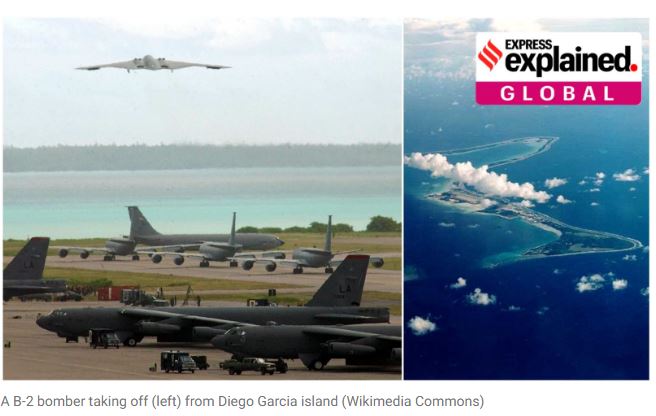
Diego Garcia is a crucial military installation jointly operated by the United States and the United Kingdom. Located in the central Indian Ocean, it serves as a key logistics and operational hub for long-range military missions.
The base has historically supported operations in regions such as the Middle East and Afghanistan and is strategically positioned between major maritime chokepoints, including the Red Sea and Southeast Asia.
Its facilities enable deployment of heavy bombers, surveillance aircraft, and pre-positioned military assets, making it central to power projection across Asia, Africa, and the Gulf region.
Geopolitical and Legal Dimensions
Diego Garcia is part of the Chagos Archipelago, which has been subject to international legal disputes. The International Court of Justice ruled in 2019 that the separation of the islands from Mauritius was unlawful.
Subsequently, sovereignty over the islands was transferred to Mauritius in 2025, while the base continues to operate under long-term lease arrangements for strategic purposes.
Strategic Implications of the Strike Attempt
The attempted strike carries far-reaching implications:
- It indicates a possible expansion of Iran’s missile range, altering regional and global threat perceptions
- A 4,000 km strike radius potentially brings parts of Europe and key global assets within reach
- It challenges existing missile defence systems, highlighting vulnerabilities
- Signals a shift from regional conflict to broader geopolitical confrontation
Broader Escalation Strategy
The incident appears to be part of a wider Iranian strategy involving missile strikes, drone attacks, and threats to countries hosting foreign military bases. This reflects a combination of conventional military capability and asymmetric warfare tactics, increasing instability in global energy and trade networks.
Conclusion
The attempted strike on Diego Garcia marks a critical moment in the evolving geopolitical landscape. It underscores the growing complexity of modern warfare, where advancements in missile technology can rapidly alter strategic balances.
For the international community, it highlights the need for enhanced diplomatic engagement, stronger defence preparedness, and robust global security frameworks to manage emerging threats.