
Vision Document on Drug Control (2026–2029) & NCB Annual Report 2025
- 03 Jul 2026
In News:
The Union Home Minister recently chaired the 10th Apex-Level Meeting of the Narco-Coordination Centre (NCORD), during which the Vision Document on Drug Control (2026–2029) and the NCB Annual Report 2025 were released. Together, these documents provide a comprehensive roadmap for combating narcotics while highlighting emerging trafficking patterns and evolving security challenges.
Narco-Coordination Centre (NCORD)
The Narco-Coordination Centre (NCORD) is the apex coordination mechanism under the Ministry of Home Affairs (MHA) for combating drug trafficking and narcotics-related crimes. It brings together Central Ministries, State Governments, intelligence agencies, enforcement organisations, financial investigation agencies and border security forces to ensure a coordinated national response.
Vision Document on Drug Control (2026–2029)
The Vision Document outlines India's medium-term anti-drug strategy with the objective of reducing both the demand and supply of narcotic drugs. Built around the principle of "Detect, Disrupt and Destroy", the strategy marks a shift from merely arresting drug couriers to dismantling entire trafficking ecosystems by targeting suppliers, financiers, handlers, facilitators and organised syndicates.
A major objective of the roadmap is to identify and dismantle 100 major interstate and transnational drug cartels through intelligence-led investigations and coordinated operations.
Key Focus Areas
The strategy adopts a Whole-of-Government Approach, involving more than 40 Ministries, Central agencies, State Governments, educational institutions, civil society organisations and citizens under a unified national framework.
It also proposes several institutional reforms:
- Amendment of the NDPS Act and Rules to plug legal loopholes and strengthen regulation of emerging synthetic drugs.
- Establishment of exclusive NDPS Courts for speedy investigation and trial.
- Mandatory financial investigations in major narcotics cases and wider use of the PITNDPS Act, 1988 to attach proceeds of crime.
- Greater international cooperation through Red Corner Notices and intelligence sharing.
- Adoption of AI-based profiling, anti-drone technologies, container scanners and advanced surveillance across land, maritime and air routes.
- Special focus on controlling methamphetamine, mephedrone and other synthetic drugs, along with tighter regulation of precursor chemicals.
NCB Annual Report 2025: Major Findings
The report highlights the rapidly evolving nature of India's narcotics challenge. During 2025, enforcement agencies registered more than 1.48 lakh cases and seized over 1,200 tonnes of narcotic drugs, psychotropic substances, pharmaceuticals and precursor chemicals, indicating the increasing scale and complexity of drug trafficking.
One of the most significant developments is the shift in the global drug supply chain. Myanmar has overtaken Afghanistan as the principal source of illicit opium for India. While the Taliban's ban on poppy cultivation sharply reduced production in Afghanistan, cultivation expanded in Myanmar's Golden Triangle, particularly in Shan State, which has emerged as a major hub for both heroin and methamphetamine production.
Emerging Drug Trafficking Routes
India's North-Eastern region has become increasingly vulnerable due to its proximity to Myanmar and porous international borders.
The report identifies two major trafficking corridors:
- Manipur Corridor through National Highway-102, serving as the primary land route for heroin and methamphetamine.
- Champhai Corridor (Mizoram) connecting Myanmar's Chin State with Aizawl and Silchar.
Beyond narcotics, these routes are increasingly linked with arms smuggling, insurgent financing and organised crime, making them a significant internal security concern.
On the western frontier, trafficking networks continue to exploit land and maritime routes through Punjab, Rajasthan, Gujarat and Maharashtra. The most notable trend is the sharp rise in drone-based cross-border smuggling from Pakistan, with drone incidents increasing from 3 cases in 2021 to 305 cases in 2025, reflecting growing technological sophistication among trafficking networks.
Digitalisation of Drug Trafficking
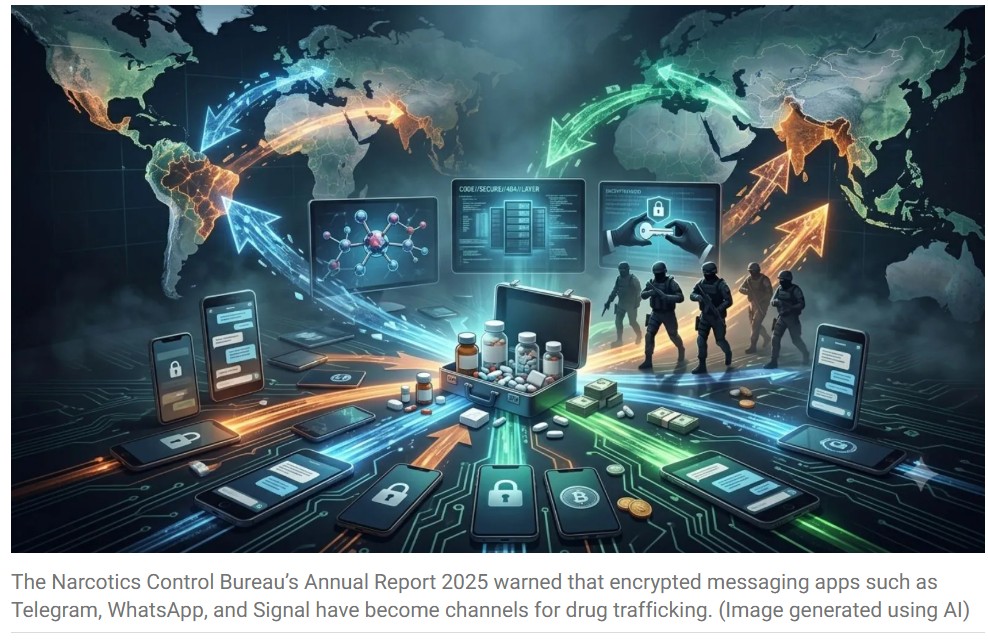
The report highlights a growing shift towards encrypted digital platforms such as Telegram, WhatsApp and Signal for communication, drug advertising and financial transactions. The use of cryptocurrencies, anonymous accounts and auto-deleting messages has made detection and investigation significantly more difficult than conventional trafficking methods.
Another emerging concern is the spread of Nitazenes, a new generation of synthetic opioids reported to be several hundred times more potent than heroin, posing serious public health and law enforcement challenges.
Challenges
Despite significant enforcement efforts, India continues to face multiple challenges:
- Expansion of synthetic drug markets.
- Porous international borders.
- Growing use of drones and encrypted communication.
- Nexus between drug trafficking, organised crime and terrorism.
- Easy availability of precursor chemicals.
- Increasing digitalisation of trafficking networks.
Significance
The Vision Document on Drug Control (2026–2029) marks a strategic transformation in India's anti-narcotics policy by shifting the focus from isolated enforcement actions to dismantling organised criminal networks. Coupled with the findings of the NCB Annual Report 2025, it highlights that narcotics trafficking today is not merely a law-and-order issue but a multidimensional challenge involving internal security, terrorism, financial crime, cyber technology, border management and public health. Strengthening inter-agency coordination, leveraging technology, disrupting financial networks and expanding international cooperation will be central to achieving the vision of a Nasha Mukt Bharat (Drug-Free India).