
DefenceAtmanirbharta
- 24 Nov 2025
In News:
India’s defence sector has undergone a structural transformation over the past decade, marked by record production, expanding exports, and deepening indigenisation. In FY 2024–25, India achieved its highest-ever defence production of ?1.54 lakh crore, while defence exports touched a record ?23,622 crore, reflecting the tangible outcomes of the Atmanirbhar Bharat vision in the strategic domain. This shift signifies India’s transition from one of the world’s largest defence importers to an emerging global manufacturing and export hub.
Rising Production and Export Trajectory
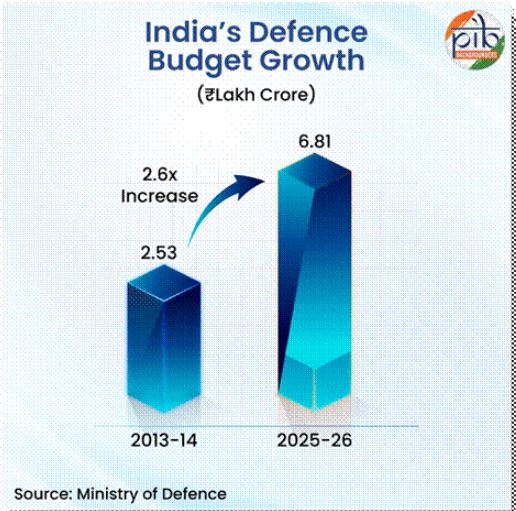
Indigenous defence production rose sharply from ?46,429 crore in FY 2014–15 to ?1,27,434 crore in FY 2023–24, registering a growth of about 174%. This expansion has been supported by sustained budgetary commitment, with the defence budget increasing from ?2.53 lakh crore (2013–14) to ?6.81 lakh crore (2025–26). In FY 2024–25 alone, the Ministry of Defence signed 193 contracts worth ?2.09 lakh crore, of which 177 contracts were awarded to domestic industry, reinforcing the “Buy Indian” approach.
Defence exports, once negligible at less than ?1,000 crore in 2014, have grown steadily, with India now exporting to 80–100 countries. Both Defence Public Sector Undertakings (DPSUs) and the private sector have contributed, with the latter’s share rising to 23%, supported by nearly 16,000 MSMEs supplying subsystems, components, and niche technologies.
Policy Reforms Driving Self-Reliance
This growth has been underpinned by far-reaching reforms. The Defence Acquisition Procedure (DAP) 2020prioritised the Buy (Indian–IDDM) category, streamlined approvals, and embedded advanced technologies such as AI, cyber, and space systems into procurement. Complementing this, the Defence Procurement Manual (DPM) 2025 simplified revenue procurement worth nearly ?1 lakh crore annually, standardised procedures, enhanced digitalisation, and reduced compliance burdens for industry.
Other key enablers include Positive Indigenisation Lists restricting imports of thousands of items, liberalisedFDI norms (74% automatic, 100% via approval), the ?1 lakh crore Research, Development and Innovation (RDI) Scheme, and innovation platforms such as iDEX and the Technology Development Fund. The restructuring of the Ordnance Factory Board into seven DPSUs improved autonomy and efficiency, while Defence Industrial Corridors in Uttar Pradesh and Tamil Nadu attracted over ?9,000 crore in investments, creating manufacturing clusters.
Defence Exports as Strategic Outreach
Export facilitation has been simplified through digital authorisation portals, Open General Export Licences, and rationalised SOPs, resulting in faster clearances and a wider exporter base. Defence exports are increasingly viewed as instruments of diplomacy, fostering interoperability, long-term partnerships, and strategic trust through training, maintenance, and logistics support alongside equipment sales.
Persistent Challenges
Despite progress, challenges remain. India still depends on imports for critical technologies such as propulsion systems, advanced sensors, electronics, and special materials. Production scale is yet to fully match the Armed Forces’ growing requirements, and DPSUs face stiff competition in global markets. Policy–implementation gaps, bureaucratic delays, and dependence on foreign supply chains continue to constrain competitiveness.
Way Forward
Sustaining momentum requires deep-tech capability building, higher defence R&D spending, stronger private-sector participation, and accelerated procurement reforms. Leveraging export diplomacy, long-term procurement commitments, and ecosystem-based innovation can help India achieve its targets of ?3 lakh crore defence production and ?50,000 crore exports by 2029.
Conclusion
India’s defence sector has entered a decisive phase of Atmanirbharta, with record production, rising exports, and a broad-based industrial ecosystem. If structural reforms are consistently implemented and technological depth is strengthened, India is well-positioned to emerge as a globally competitive defence manufacturing hub by the end of this decade, enhancing both national security and economic growth.