
‘Sapt Dhara’ (Seven Streams of Strength)
- 18 Aug 2026
In News:
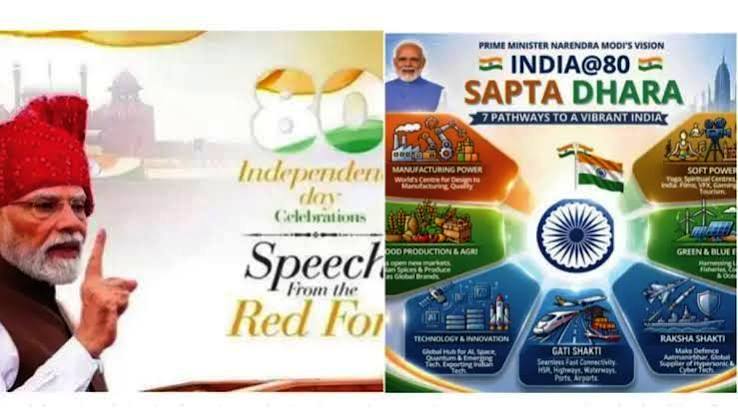
On India’s 80th Independence Day, the Prime Minister outlined ‘Sapt Dhara’ (Seven Streams of Strength) as a strategic framework to accelerate India’s transformation into a Viksit Bharat by 2047. The framework seeks to complement the Panch Pran announced in 2022 by translating its broader civic and ideological vision into sectoral priorities and capability-building.
Seven Streams of Strength
1. Manufacturing: India aims to build complete domestic value chains—from components and design to finished products—and become a trusted global supply-chain hub. Quality, precision manufacturing, MSME competitiveness and global market access through FTAs are central to this objective.
2. Agriculture & Food Production: The focus is on moving from farm to export market through food processing, value addition, chemical-free farming and integration with global markets. Affordable fertilisers remain an important support to farmers, with urea and DAP being provided at ?300 and ?1,350 respectively against much higher global prices.
3. Technology & Innovation: India seeks to become an innovation hub rather than merely a technology market, with emphasis on AI, quantum technology, space, robotics, data centres, semiconductors, UPI, DPI and indigenous 6G technologies.
4. Gati Shakti: Multimodal connectivity through high-speed rail, highways, inland waterways, airports and integrated logistics is envisaged to improve productivity and reduce logistics constraints.
5. Defence Power: The objective is defence self-reliance and global defence-supplier status, with priorities including drones, counter-drone systems, hypersonic technologies and cybersecurity. Defence exports have increased nearly 50-fold, reaching around 100 countries.
6. Green & Blue Economy: India seeks leadership in renewable energy, green hydrogen, energy storage, green mobility, green manufacturing and ocean-based sectors. The framework targets 100 GW nuclear capacity by 2047, while solar capacity has risen from 2 GW to 160 GW.
7. Soft Power: Yoga, Ayurveda, culture, handicrafts, films, VFX, animation, gaming, tourism and creative industries are viewed as instruments of India’s global influence.
Panch Pran and Sapt Dhara
The Panch Pran provides the moral and civic foundation—developed India, removal of colonial mindset, pride in heritage, unity and integrity, and a sense of duty. Sapt Dhara, in contrast, provides the sectoral and strategic pathway for translating these aspirations into economic, technological and institutional capabilities.
Way Forward
Realising Viksit Bharat requires stable reforms, human-capital development, innovation, competitive manufacturing, energy security, social inclusion and cooperative Centre-State-local governance. The emphasis must shift from merely achieving targets to building globally competitive capabilities while ensuring that growth remains inclusive and sustainable.
Conclusion
Panch Pran defines the national ethos, while Sapt Dhara defines the pathway. Together, they seek to combine citizen participation, self-reliance, technological capability, economic competitiveness and strategic strength to transform India into a developed nation by 2047.