
Indus Waters Treaty (IWT)
- 18 May 2026
In News:
Signed on September 19, 1960, under the mediation of the World Bank, the Indus Waters Treaty (IWT) has long been regarded as one of the world's most resilient transboundary water sharing agreements. However, India's recent categorical rejection, "award" by the Court of Arbitration (CoA) at The Hague, coupled with New Delhi’s unprecedented decision to place the treaty in abeyance following the April 22 Pahalgam terror attack, marks a fundamental paradigm shift in India's bilateral water diplomacy.
Core Architecture of the Treaty
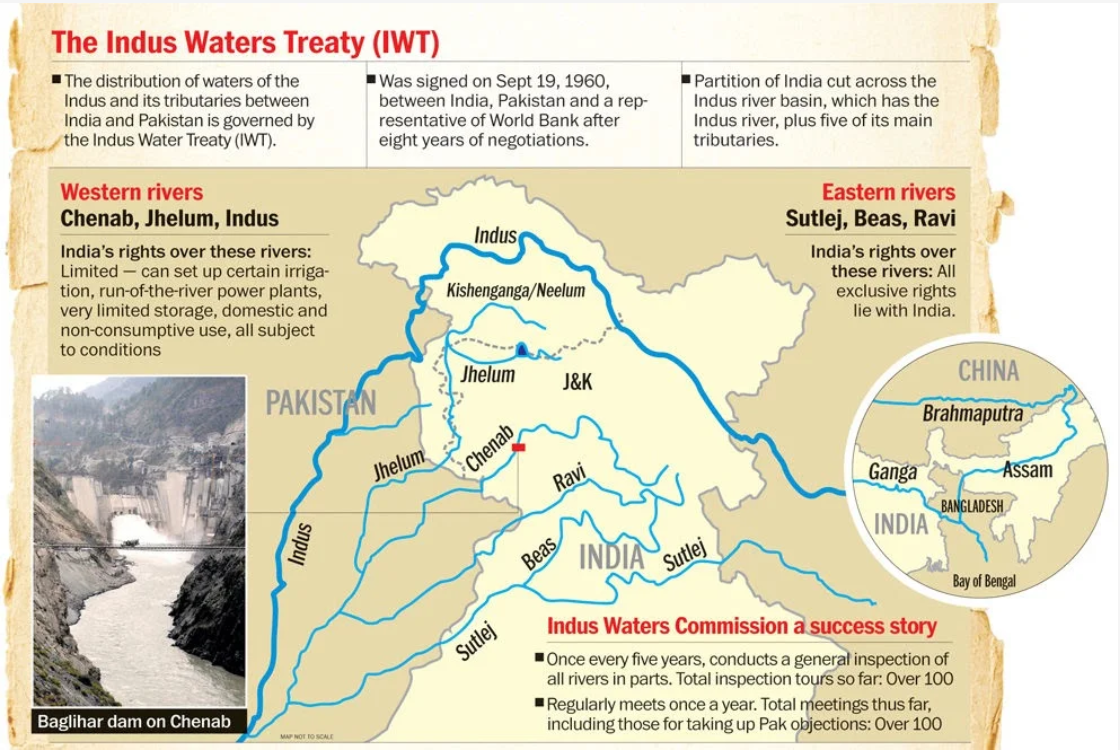
The treaty comprises 12 Articles and 8 Annexures (A to H), establishing a clear division of the Indus river basin system:
- Eastern Rivers (Sutlej, Beas, Ravi): Allocated to India for "unrestricted use."
- Western Rivers (Indus, Jhelum, Chenab): Allocated primarily to Pakistan. India retains limited, conditional rights for hydropower generation, non-consumptive use, and irrigation.
The Graded Dispute Resolution Mechanism & Current Deadlock
Article IX of the IWT outlines a structured, three-tier mechanism to resolve technical or legal conflicts:
- Permanent Indus Commission (PIC): The foundational tier consisting of Commissioners from both nations meeting regularly to resolve issues via mutual consensus.
- Neutral Expert (NE): Appointed by the World Bank for technical differences (e.g., engineering designs of India's Kishenganga or Ratle projects) whose decision is binding.
- Court of Arbitration (CoA): A 7-member ad hoc arbitral tribunal at The Hague for broader legal and contractual interpretations.
The Conflict over Jurisdiction
The current diplomatic and legal deadlock stems from Pakistan's parallel activation of both the NE and the CoA mechanisms regarding maximum pondage disputes. India contends that a nation cannot simultaneously pursue both tracks under the treaty's graded hierarchy. Consequently, India boycotted the CoA, labeling it "illegally constituted" and declaring its recent May 2026 pronouncements "null and void."
Strategic Escalation: The Shift in India's Approach
India’s hydro-diplomacy has grown progressively assertive, reflecting the principle that "blood and water cannot flow together":
- January 2023: India issued its first-ever formal notice seeking "modification" of the treaty due to Pakistan's obstructionist approach.
- September 2024: India escalated by issuing a notice for "review and modification," signaling an intent to fundamentally renegotiate the 65-year-old framework.
- May 2026: Following the Pahalgam terror attack (which resulted in 26 deaths), India placed the treaty in abeyance, establishing a direct link between regional national security and international treaty obligations.
Key Legal and Diplomatic Challenges
- Treaty Continuity vs. National Security: The standoff tests whether a bilateral treaty can be unilaterally held in abeyance under international law due to cross-border terrorism.
- Multilateral Overreach: India opposes the internationalization of bilateral issues through third-party arbitration bodies like the CoA that bypass sequential treaty mechanisms.
Way Forward
- Modernization of the Treaty: The IWT must be renegotiated to incorporate 21st-century realities, including climate resilience, altered hydrology, data-sharing, and updated dispute-resolution channels.
- Basin-Wide Management: South Asia requires sustainable, cooperative river basin management based on mutual trust and absolute cessation of cross-border security threats.
Conclusion
India’s rejection of the CoA award demonstrates that hydro-relations cannot exist in a vacuum separated from national sovereignty and security. The long-term stability of the Indus basin hinges upon Pakistan embracing institutional dialogue and adhering to the treaty’s defined legal protocols.