
Passive Euthanasia in India
- 30 Nov 2025
In News:
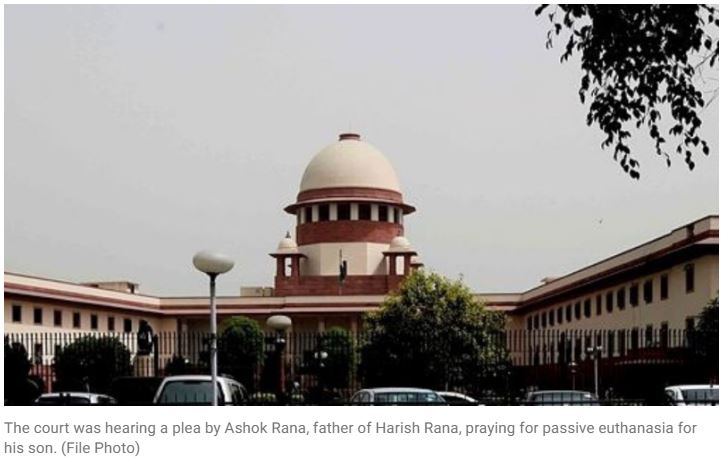
In a recent case, the Supreme Court directed the District Hospital, Noida, to constitute a Primary Medical Board to examine whether life-sustaining treatment can be withdrawn for a 32-year-old man in a persistent vegetative state (PVS) for over 12 years. The petition, filed by the patient’s father, sought passive euthanasia, not active intervention. The Court, while acknowledging the patient’s irreversible condition and total disability, reaffirmed that any decision must strictly follow the safeguards laid down in its earlier judgments, and sought a medical report within two weeks before taking a final call.
Understanding Euthanasia and Persistent Vegetative State
A Persistent Vegetative State (PVS) is a condition where higher brain functions such as awareness and cognition are irreversibly lost, while basic functions like breathing, circulation and reflexes continue.
Euthanasia refers to intentionally accelerating death to relieve suffering from an incurable condition and is broadly of two types:
- Active Euthanasia: Direct action to end life (illegal in India).
- Passive Euthanasia: Withholding or withdrawing life-sustaining treatment, allowing natural death.
India permits only passive euthanasia, subject to strict legal and procedural safeguards.
Legal Position in India
Indian law does not recognise an unfettered “right to die” under Article 21, but the Supreme Court has interpreted the right to life to include the right to die with dignity in exceptional circumstances.
- Active euthanasia is prohibited and punishable under the Bharatiya Nyaya Sanhita, 2023, as culpable homicide or murder.
- Passive euthanasia is legally permissible under judicially evolved safeguards.
Key judicial milestones include:
- Aruna Shanbaug case (2011): Allowed withdrawal of life support for incompetent patients under court supervision.
- Common Cause case (2018): Recognised passive euthanasia and validated advance medical directives (living wills) for competent adults.
- 2023 modifications: Simplified procedures by reducing medical board size and experience requirements, and setting clear timelines to make the process workable.
Procedural Safeguards
The Supreme Court mandates a two-tier medical review:
- Primary Medical Board constituted by the hospital.
- Secondary Medical Board at the district level.
These boards assess the medical condition, irreversibility, and best interests of the patient. Judicial oversight ensures protection against misuse while respecting dignity.
Ethical Dimensions
The euthanasia debate reflects a tension between competing ethical principles:
- Arguments in favour emphasise autonomy, compassion, minimisation of suffering, and rational allocation of scarce medical resources.
- Arguments against stress the sanctity of life, the doctor’s duty of non-maleficence, risks of a slippery slope, and erosion of trust in medical ethics.
India’s approach attempts a middle path rejecting active killing while permitting dignified death in narrowly defined circumstances.
Global Perspective
Countries such as the Netherlands and Belgium permit both euthanasia and assisted suicide under strict laws, while others like Switzerland allow assisted suicide but prohibit active euthanasia. These variations show that euthanasia is shaped as much by societal values as by medical capability.
Conclusion
The Supreme Court’s direction to constitute a medical board reflects India’s cautious, dignity-centric approach to end-of-life decisions. By balancing compassion with safeguards, autonomy with ethics, and medical judgment with judicial oversight, India seeks to ensure that death, when inevitable, is humane rather than mechanical. As medical technology prolongs biological life, evolving jurisprudence on passive euthanasia will remain crucial to uphold constitutional morality, human dignity and ethical restraint.