
Declining Health of Parliamentary Democracy in India
- 01 Dec 2025
In News:
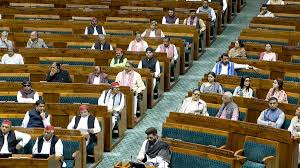
India’s Parliament, constitutionally envisaged as the “grand inquest of the nation”, is increasingly witnessing signs of institutional fatigue. As the Winter Session reconvenes amid controversies such as the Special Intensive Revision (SIR) of electoral rolls, concerns over legislative dysfunction, shrinking deliberation, and executive dominance have resurfaced. This decline is not episodic or partisan, but structural and long-term, threatening the balance of power central to parliamentary democracy.
Empirical Evidence of Decline
Data from PRS Legislative Research reveal a worrying trend. During a recent Monsoon Session, the Lok Sabha functioned for only 29% of its scheduled time and the Rajya Sabha for 34%. Question Hour—the most potent accountability mechanism—was particularly eroded, with the Lok Sabha completing only 23% and the Rajya Sabha merely 6% of its allotted time.
Equally concerning is the rushed passage of legislation. Major Bills such as the Regulation of Online Gaming Bill and the Merchant Shipping Bill were cleared with only minutes of discussion, undermining the deliberative purpose of Parliament under Article 107. Committee scrutiny has weakened sharply: while over 60% of Bills were referred to committees in the 14th and 15th Lok Sabhas, this figure fell to about 20% in the 16th and 17th.
The number of sittings has also declined dramatically. From an average of 121 days per year (1952–1970), Parliament now meets for about 68 days, with the 17th Lok Sabha averaging just 55 days, the lowest in independent India. Notably, it was also the first Lok Sabha without a Deputy Speaker, despite Article 93 mandating the post.
Structural Causes
A key driver of institutional erosion is the Anti-Defection Law. Intended to curb political instability, it has instead suppressed legislative independence, converting MPs into bound agents of party whips. This distorts core parliamentary functions such as:
- Power of the purse, where financial scrutiny becomes ritualistic.
- Impeachment proceedings, where MPs should act as impartial jurors rather than whipped voters.
Simultaneously, executive dominance has grown. Opposition notices, adjournment motions, and demands for discussion are frequently disallowed, forcing protests and disruptions. Presiding officers, constitutionally expected to be neutral, are increasingly perceived as partisan, further weakening trust in parliamentary conventions.
Comparative Perspective
India’s parliamentary system draws from the Westminster model, whose roots lie in the Oxford Parliament of 1258, which subordinated executive power to legislative oversight. In countries like the UK, Prime Minister’s Questions, strong committee systems, and mandatory executive testimony preserve accountability. India, by contrast, has moved in the opposite direction—towards a Parliament that often approves rather than scrutinises.
Way Forward
Reversing this decline requires deliberate reforms:
- Mandating minimum sittings (e.g., 120 days annually) to prevent rushed law-making.
- Compulsory committee referral for all major Bills.
- Reforming the Anti-Defection Law, limiting whips to confidence motions and Money Bills.
- Restoring Question Hour and Zero Hour as non-negotiable accountability tools.
- Institutionalising a Prime Minister’s Question Hour and strengthening executive accountability to committees.
- Upholding neutrality of constitutional offices, including timely election of the Deputy Speaker.
Conclusion
The decline of Parliament is not merely about productivity statistics but about the hollowing out of constitutional spirit. Without urgent corrective measures, India risks reducing Parliament to a symbolic edifice—standing tall, yet silent in its duty to hold power accountable to the people. Reviving parliamentary democracy is thus essential for preserving the republic’s constitutional balance and democratic legitimacy.