
DRDO’s Rocket-Sled Ejection Test
- 09 Dec 2025
In News:
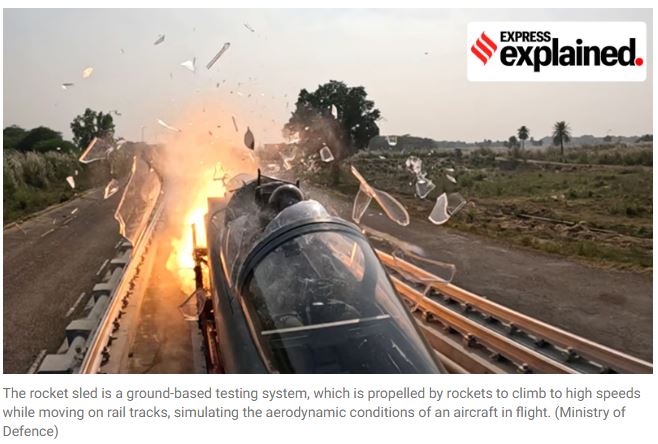
India recently achieved a significant milestone in aerospace safety with the successful high-speed rocket-sled test of a fighter aircraft escape system conducted by the Defence Research and Development Organisation (DRDO). The test, carried out at the Rail Track Rocket Sled (RTRS) facility of the Terminal Ballistics Research Laboratory (TBRL), Chandigarh, marks a major step in strengthening India’s indigenous capability in pilot survival technologies. This achievement places India among a select group of nations capable of conducting such advanced dynamic ejection tests domestically.
What is a Rocket-Sled Ejection Test?
A rocket-sled test simulates real flight conditions on the ground to evaluate the performance of a fighter aircraft’s ejection system. These systems are critical life-saving mechanisms designed to enable pilots to safely escape during emergencies such as engine failure, loss of control, or combat damage. Unlike static tests, dynamic ejection tests recreate high-speed aerodynamic forces, making them the true benchmark for validating escape systems.
In this test, DRDO collaborated with the Aeronautical Development Agency (ADA) and Hindustan Aeronautics Limited (HAL). Using a dual-sled configuration, the forebody of the Light Combat Aircraft (LCA) was mounted on a rail system and propelled using multiple solid rocket motors in a phased sequence. The system reached a controlled speed of about 800 km/h, closely replicating in-flight conditions.
What Was Tested?
The trial validated key aspects of the escape sequence:
- Canopy severance (safe removal or shattering of the cockpit canopy)
- Ejection seat firing and sequencing
- Stabilisation and parachute deployment
- Complete aircrew recovery process
An instrumented anthropomorphic test dummy was used to simulate a pilot. Equipped with sensors, it recorded loads, accelerations, and rotational forces experienced during ejection. High-speed cameras and onboard imaging systems captured the entire sequence for analysis.
Why Are Dynamic Tests Crucial?
Ejection may be required under highly unpredictable conditions - low or high altitude, zero or high speed, inverted flight, or aircraft spin. The system must function within millisecond precision. Even minor delays or sequencing errors can cause severe injury or fatality. Dynamic tests therefore ensure the system performs reliably across diverse real-world scenarios, in line with global aviation safety standards.
Strategic and Technological Significance
Until now, India depended on foreign facilities for such advanced testing, which was costly and time-consuming. Indigenous testing reduces costs to nearly one-fourth or one-fifth of overseas trials and significantly shortens development cycles. This capability supports not only current platforms like the LCA Tejas, but also future indigenous fighter programmes.
The RTRS facility, operational since 2014, has also supported other national missions, including testing Gaganyaan drogue parachutes. With upgrades such as high-speed imaging and precision measurement systems, it now matches international standards for dynamic aerospace testing.
Conclusion
The successful rocket-sled ejection test represents a major leap in Atmanirbhar Bharat in defence aerospace. By developing in-house capability to test and certify critical pilot survival systems, India enhances operational readiness, reduces foreign dependence, and strengthens its position as an emerging aerospace power. Ultimately, this progress translates into greater pilot safety and improved combat reliability of Indian fighter aircraft.