
Nepal’s Climate Compensation Demand
- 10 Sep 2026
In News:
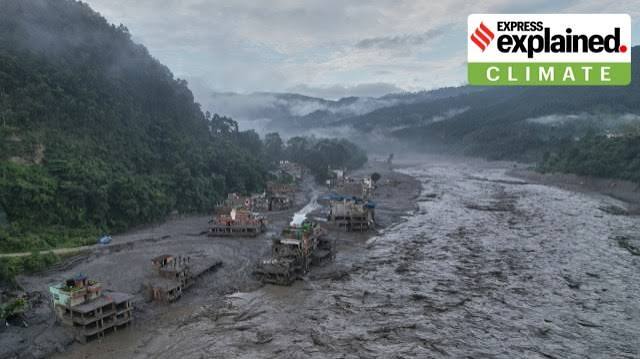
In the aftermath of a devastating rock-ice avalanche and flash flood in August 2026, Nepal has renewed calls for climate compensation from major greenhouse-gas-emitting countries, arguing that vulnerable developing nations are bearing a disproportionate share of the impacts of a warming climate. The disaster inflicted an estimated US$4–7 billion in economic losses—equivalent to nearly 10% of Nepal’s GDP—and destroyed around 10% of the country’s installed hydropower capacity, highlighting the growing economic and developmental risks posed by climate-induced disasters.
Why is Nepal demanding climate compensation?
- Low contribution, high vulnerability: Nepal contributes only about 0.1% of global GHG emissions, while the Hindu Kush Himalayas are experiencing rapid warming and glacier-related changes.
- Climate justice: Nepal argues that countries that have contributed relatively little to climate change are bearing disproportionate costs from climate-induced disasters.
- Economic burden: Damage to hydropower infrastructure can transform Nepal from an electricity exporter into an importer and increase dependence on borrowing for reconstruction.
- Responsibility: The article distinguishes between historical responsibility for cumulative emissions and proximate/current responsibility associated with major contemporary emitters.
Key International-Law Issue
The major limitation is Article 8 of the Paris Agreement.
It recognises the importance of Loss and Damage, but explicitly states that this provision does not provide a basis for liability or compensation. Therefore, establishing a legal claim against a particular emitter under the UNFCCC/Paris framework remains difficult.
Why is legal attribution difficult?
A compensation claim would require demonstrating a causal connection between anthropogenic climate change and a specific disaster. In Nepal’s case, the interaction of:
- seismic activity,
- local geomorphology,
- weather patterns, and
- climate-induced cryospheric changes
makes direct legal attribution complex.
Implications for India
The issue is significant for India because the article highlights:
- CBDR-RC: India has traditionally argued that developed countries with greater historical emissions should bear greater responsibility for climate action and finance.
- Regional responsibility: Nepal’s argument places greater pressure on major South Asian emitters to support vulnerable neighbouring countries.
- Hydropower: Restrictions related to cross-border electricity trade and projects involving Chinese capital can affect Nepal’s ability to recover economically from hydropower losses.
- Transboundary disasters: Himalayan hazards such as GLOFs and glacier destabilisation can affect downstream countries, including India.
Way Forward
The article proposes:
- Transboundary Himalayan early-warning systems
- Real-time hydrometeorological and satellite data sharing
- A regional catastrophe insurance/risk-pooling mechanism
- Greater regional cooperation in hydropower and electricity trade
- Rapid-disbursement mechanisms under the Loss and Damage framework to reduce vulnerable countries’ dependence on debt.