
Strait of Hormuz Disruption and India’s Energy Security
- 02 Mar 2026
In News:
Escalating tensions involving Iran, the United States, and Israel have disrupted shipping movements through the Strait of Hormuz, the world’s most critical energy chokepoint. Although no formal closure has been declared, heightened military activity and security risks have led insurers, traders, and shipping firms to suspend operations, with numerous oil tankers anchored in Gulf waters. The situation raises serious concerns for India’s energy security, given its heavy dependence on West Asian energy supplies.
Strategic Importance of the Strait of Hormuz
The Strait of Hormuz connects the Persian Gulf to the Gulf of Oman and the Arabian Sea and handles nearly one-fifth of global petroleum and LNG trade. Approximately 15 million barrels of crude oil per day pass through this narrow corridor. Even if alternative Gulf pipelines operate at full capacity, a significant portion of global supply would remain exposed in the event of sustained disruption.
Thus, any instability in this region directly affects global oil prices and supply chains.
India’s Energy Dependence
India is the world’s third-largest oil consumer and imports over 88% of its crude oil requirements. Roughly 2.5–2.7 million barrels per day, accounting for about half of India’s crude imports, transit through the Strait of Hormuz. India also relies heavily on West Asia for LPG and LNG supplies, making uninterrupted maritime flows crucial for economic stability.
Impact on India
1. Crude Oil: Manageable in the Short Term
India is relatively better prepared to handle short-term crude disruptions due to:
- Refiners holding over 10 days of crude inventory
- Around one week of fuel stocks
- Availability of Strategic Petroleum Reserves (SPR)
Additionally, India can diversify imports by sourcing crude from Russia, the United States, West Africa, and Latin America. Russian supplies, including cargoes in floating storage, offer flexibility.
However, even if supply continuity is maintained, price volatility remains a major concern. Brent crude has already crossed $72 per barrel, and prolonged conflict could push prices beyond $100 per barrel, increasing inflationary pressures and widening India’s current account deficit.
2. LPG: A Greater Vulnerability
India imports 80–85% of its LPG requirements, largely from Gulf suppliers via the Strait. Unlike crude oil, India does not maintain substantial strategic LPG reserves. A prolonged disruption could therefore affect domestic cooking fuel supplies and increase subsidy burdens.
3. LNG: Limited Structural Cushion
Around 60% of India’s LNG imports transit through the strait. LNG markets are tighter compared to crude oil, and spot cargo availability is limited. In case of extended disruption, India may face difficulties in securing alternative supplies, affecting power generation and industrial output.
Price Outlook and Duration
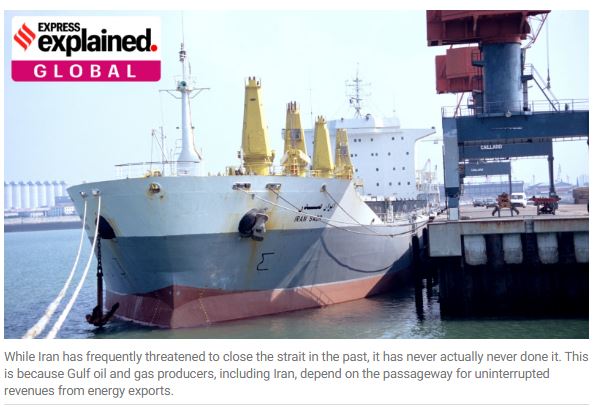
The extent of impact will depend on the duration and intensity of the conflict. Escalation may add a “war premium” to oil prices. However, a full closure remains unlikely because Gulf producers including Iran depend heavily on energy exports for revenue. This mutual economic interdependence reduces the probability of a prolonged, total blockade.
Conclusion
The Strait of Hormuz crisis highlights India’s structural vulnerability to geopolitical disruptions in West Asia. While diversified crude sourcing and strategic reserves provide short-term resilience, LPG and LNG dependence remain key risk areas. The episode reinforces the need for long-term strategies including energy diversification, expansion of strategic reserves, renewable energy transition, and strengthened maritime security diplomacy. Ensuring energy security will remain central to India’s economic and strategic stability in an increasingly volatile global order.