
US–Israel Strikes on Iran and the Escalating West Asian Conflict
- 03 Mar 2026
In News:
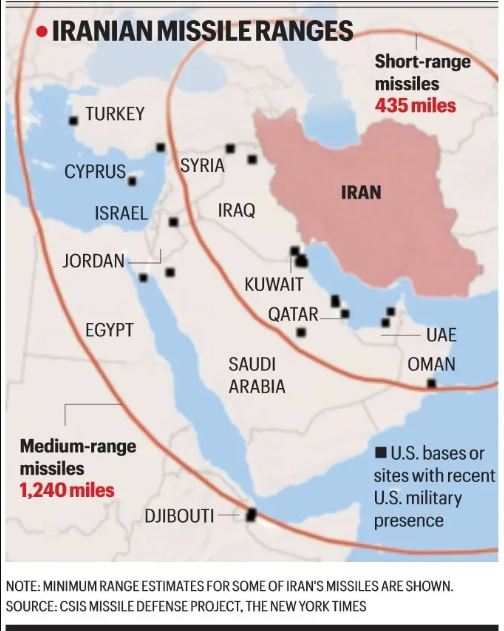
The coordinated military strikes by the United States and Israel on Iran in 2026 have triggered a major escalation in West Asia. The operations - Operation Epic Fury (US) and Operation Lion’s Roar (Israel) -reportedly targeted Iran’s strategic military infrastructure and leadership, including the killing of Iran’s Supreme Leader Ayatollah Ali Khamenei. Iran retaliated through Operation True Promise 4, launching missile attacks against Israel and nearby Gulf states. This escalation has heightened concerns of a wider regional war, particularly as it occurred amid ongoing negotiations over Iran’s nuclear programme.
Background of the US–Iran–Israel Conflict
1. The 1979 Iranian Revolution: Prior to 1979, Iran and Israel maintained close strategic ties. However, the Islamic Revolution transformed Iran’s foreign policy orientation. The new regime severed ties with Israel and adopted an anti-Western stance, describing the United States as the “Great Satan” and Israel as the “Little Satan.”
2. Iran’s Nuclear Programme: Tensions intensified in the early 2000s when the international community uncovered Iran’s covert nuclear programme, raising concerns over possible nuclear weapon development.
3. Regional Influence and the “Axis of Resistance”: Following the US-led invasion of Iraq in 2003, Iran expanded its regional influence by supporting proxy groups collectively referred to as the “Axis of Resistance,” including Hezbollah (Lebanon), Hamas (Gaza), and the Houthis (Yemen).
4. Joint Comprehensive Plan of Action (JCPOA), 2015: The nuclear deal between Iran and the P5 1 nations limited Iran’s uranium enrichment in exchange for sanctions relief.
5. US Withdrawal from JCPOA (2018): The United States withdrew from the agreement citing concerns about Iran’s missile programme and regional activities. Iran subsequently increased uranium enrichment levels.
6. Recent Escalations:
- Operation Midnight Hammer (2025): Israeli and US strikes on Iran’s nuclear facilities such as Natanz, Isfahan, and Fordow.
- Collapse of Iran’s regional influence (2023–24): Israel’s campaigns weakened Hamas and Hezbollah and destabilised allied regimes, reducing Iran’s strategic buffers.
The 2026 strikes represent a shift from deterrence to a decapitation strategy, aimed at weakening Iran’s leadership and military command structure.
Global Implications of the Conflict
1. Threat to Global Energy Security: The conflict threatens the Strait of Hormuz, a critical maritime chokepoint through which:
- Around 20 million barrels of oil per day (≈20% of global consumption) pass.
- Nearly 20–30% of global LNG shipments transit.
Any disruption could cause a sharp spike in oil prices and destabilise global energy markets.
2. Geopolitical Polarisation: The conflict risks intensifying great-power rivalries. Russia and China may strengthen ties with Iran, while the United States consolidates alliances with Western and Arab partners, deepening geopolitical divisions.
3. Disruption of Global Supply Chains: Militarisation of West Asian airspace and sea routes threatens major trade corridors linking Asia, Europe, and Africa, increasing shipping costs, insurance premiums, and trade uncertainty.
4. Financial and Commodity Market Volatility: Rising geopolitical risk has triggered a “war premium” in global markets. Safe-haven assets like gold have surged, while regional stock markets have experienced instability.
Implications for India
1. Energy Security Risks: India imports 85–88% of its crude oil requirements. About 2.5–2.7 million barrels/day of oil from Iraq, Saudi Arabia, UAE, and Kuwait pass through the Strait of Hormuz.
Additionally:
- 80–85% of LPG imports
- Nearly 60% of LNG imports
also transit through Hormuz. Prolonged disruptions could push crude prices above USD 100 per barrel, increasing inflation and widening the current account deficit.
2. Safety of Indian Diaspora: West Asia hosts nearly 9 million Indian expatriates, whose remittances significantly contribute to India’s economy. Escalation could necessitate large-scale evacuation operations similar to Operation Rahat or Operation Ajay.
3. Diplomatic Balancing: India maintains strong relations with the US and Israel, while also having historical and energy ties with Iran. Therefore, adopting a partisan stance could undermine strategic interests.
4. Connectivity and Strategic Projects: Conflict threatens India’s regional connectivity initiatives such as:
- Chabahar Port project in Iran
- India–Middle East–Europe Economic Corridor (IMEC)
Disruptions in Gulf maritime routes could undermine these strategic initiatives.
Measures for India
- Energy Security Measures:
- Utilisation of Strategic Petroleum Reserves (SPR).
- Diversification of energy imports from countries such as the US and Australia.
- Diaspora Protection:
- Prepared evacuation plans involving the Indian Navy, Air Force, and civil aviation.
- Maritime Security: Strengthen naval deployment in the Arabian Sea and Gulf of Oman and expand missions like Operation Sankalp.
- Strategic Autonomy in Diplomacy: Maintain balanced relations with all stakeholders while advocating dialogue and de-escalation.
- Economic Cushioning: Temporary reduction in fuel taxes to absorb global price shocks.
Conclusion
The escalation between the United States, Israel, and Iran represents a significant challenge to regional stability, global energy security, and international trade. For India, the conflict underscores vulnerabilities in energy dependence, diaspora safety, and strategic connectivity projects. By maintaining strategic autonomy, strengthening energy resilience, and advocating diplomatic solutions, India can safeguard its national interests while reinforcing its role as a stabilising global actor in an era where, as emphasised in its foreign policy, “this is not an era of war.”