
Rural & Tribal Development: From Welfare Delivery to Empowerment
- 19 Aug 2026
In News:
India’s rural and tribal development strategy is increasingly moving beyond welfare distribution towards capability enhancement, livelihood security, social inclusion and decentralised governance. The approach combines basic services with infrastructure, digital connectivity, financial inclusion, skilling and targeted interventions for vulnerable communities.
Strengthening the Foundations of Rural Welfare
Fiscal decentralisation has gained importance, with transfers to Panchayats rising from ?2.36 lakh crore under the 15th Finance Commission (2021–26) to ?4.35 lakh crore under the 16th Finance Commission (2026–31). Rural development allocation increased from ?87,765 crore in 2016–17 to ?2.73 lakh crore in 2026–27, while tribal affairs allocation rose to ?15,421.97 crore.
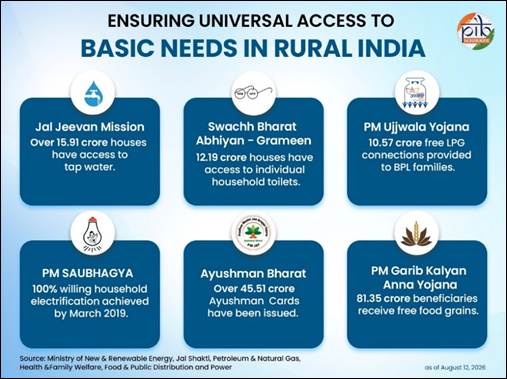
Basic services have expanded significantly. Under the Jal Jeevan Mission, rural tap-water connections rose from 3.23 crore in August 2019 to over 15.91 crore by August 2026, with about 2.89 lakh villages reporting complete household coverage. Swachh Bharat Mission-Grameen has facilitated over 12.19 crore toilets, while PM Ujjwala Yojana has provided more than 10.57 crore LPG connections to women from poor households.
Human Capital and Digital Inclusion
The emphasis is increasingly on human capabilities. Under Samagra Shiksha, 4,073 schools were upgraded and 25,000 schools received skill-education support. Female primary dropout declined from 4.6% in 2013–14 to 0.1% in 2025–26. Girls’ secondary GER increased from 75.5% to 83.4% over the same period. Kasturba Gandhi Balika Vidyalayas expanded to 5,639 sanctioned institutions.
Rural connectivity is also being strengthened through PMAY-G, PMGSY and BharatNet. Over 3.91 crore rural houses have been sanctioned under PMAY-G, while 99.6% of eligible habitations had all-weather road connectivity under PMGSY by June 2026. Around 2.19 lakh Gram Panchayats were connected through BharatNet.
From Beneficiaries to Economic Participants
DAY-NRLM has mobilised10.19 crore households into 94.46 lakh SHGs, with 3.46 crore LakhpatiDidis, highlighting the role of women-led collective enterprise. Financial inclusion has expanded through PM Jan Dhan Yojana, with accounts reaching 58.90 crore, while PM MUDRA loans crossed 59.14 crore by July 2026. PM Vishwakarma has registered over 30 lakh traditional artisans, combining skilling with toolkit support.
Tribal and Vulnerable-Group Empowerment
Tribal development increasingly follows a convergence-based approach. PM-JUGA brings together 17 Ministries, while PM-JANMAN targets Particularly Vulnerable Tribal Groups through infrastructure and livelihood interventions. Eklavya Model Residential Schools increased from 129 in 2014–15 to 511 by August 2026, serving about 1.68 lakh students.
Way Forward
The central challenge is to convert coverage into quality outcomes. Future policy must focus on effective decentralisation, quality education and healthcare, sustainable livelihoods, tribal participation, social accountability and last-mile delivery. The ultimate objective should be to transform welfare recipients into rights-bearing, economically empowered and socially secure citizens.