
UDISE 2025–26: India’s Changing School Education System
- 27 Aug 2026
In News:
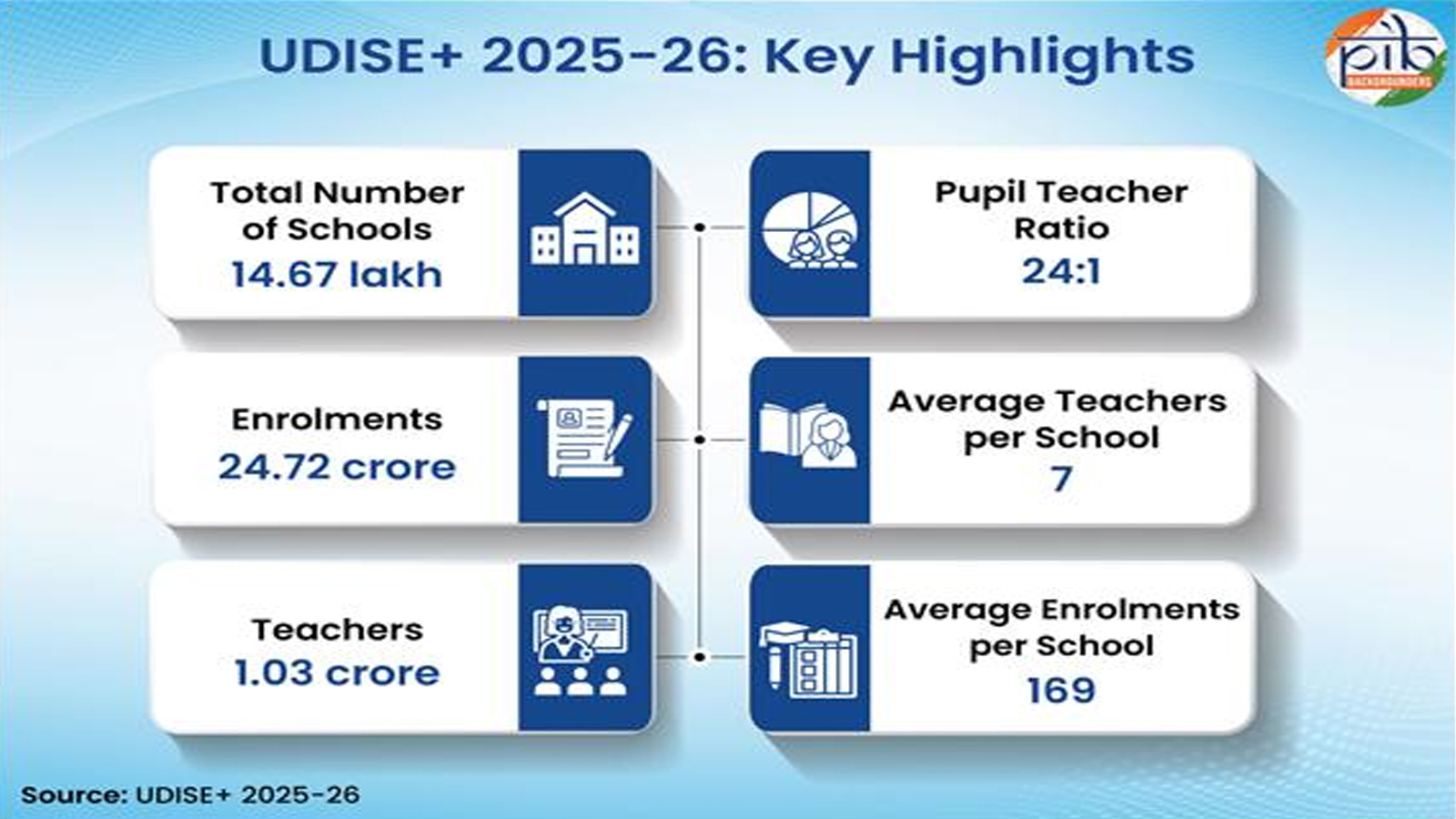
The Department of School Education and Literacy (DoSE&L) released the UDISE 2025–26 Report, providing comprehensive data on India’s school education system. It covers 14.67 lakh schools, 1.03 crore teachers and 24.72 crore students.
UDISE (Unified District Information System for Education Plus) is a major data platform for monitoring school education and supports evidence-based planning, resource allocation and implementation of the National Education Policy (NEP) 2020.
Key Findings
1. Teacher availability has improved:The overall Pupil–Teacher Ratio (PTR) is 24:1, within the NEP 2020 benchmark of 30:1. PTR is 10:1 at the Foundational stage and 21:1 at the Secondary stage.
2. Enrolment and retention:The Gross Enrolment Ratio (GER) is 89.6% at the Middle stage and 71.7% at the Secondary stage, showing wider access but continued scope for improving participation at higher levels.
- Retention rates are 98.5% at Foundational, 91.1% at Preparatory, 83.7% at Middle and 51.9% at Secondary level. The transition rate to Secondary education is 88.3%.
- Dropout rates have declined to 1.8% at Preparatory and 7% at Secondary level, although the Middle-stage dropout rate marginally increased to 3.6%.
3. Better utilisation of school resources:The number of single-teacher schools declined by about 3% to 1,00,843, while zero-enrolment schools fell by 29% to 5,663.
4. Gender and social inclusion:Girls account for 48.4% of total enrolment, while women constitute 54.9% of teachers. SC and ST students together represent 27.7% of enrolment, indicating significant participation of historically disadvantaged groups.
5. Infrastructure and digital connectivity:
- Electricity: 95% schools
- Safe drinking water: 99.5%
- Girls' toilets: 98.5%
- Libraries: 90.5%
- Computer access: 69.9%
- Internet connectivity: 67.4%
Significance
UDISE provides granular, school-level data that can help identify regional and stage-wise gaps, improve resource allocation and monitor educational outcomes. The improvements in teacher availability, retention, gender participation, basic infrastructure and digital connectivity indicate progress towards more accessible, inclusive and technology-enabled school education.