
Harnessing Artificial Intelligence for Agricultural Transformation
- 28 Nov 2025
In News:
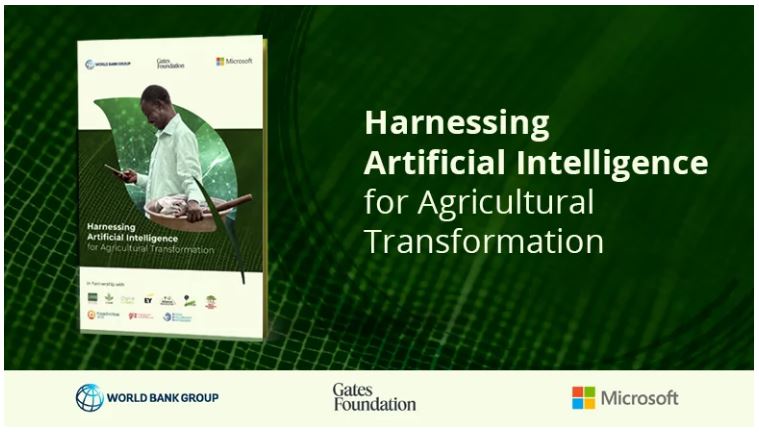
Artificial Intelligence (AI) is emerging as a powerful enabler of transformation across agrifood systems, particularly in low- and middle-income countries (LMICs) where smallholder farmers produce nearly one-third of the world’s food. The World Bank–led report “Harnessing Artificial Intelligence for Agricultural Transformation” highlights how AI, if deployed responsibly and inclusively, can enhance productivity, climate resilience, and equity while cautioning that technology alone is insufficient without enabling investments and governance.
AI and the Changing Agrifood Landscape
Recent trends show a decisive shift from isolated digital pilots to systems-level AI adoption across the entire agricultural value chain. Advances in Generative AI and multimodal models combining text, images, satellite data and sensor feeds are enabling natural-language advisories in local languages and predictive insights for farmers. Investments in AI for agriculture are rising rapidly, with the market projected to grow from about US$1.5 billion in 2023 to over US$10 billion by 2032. Importantly, LMIC-focused innovations such as lightweight “small AI” models on smartphones and offline devices are expanding reach in low-connectivity settings.
Opportunities Across the Value Chain
AI applications span crops, livestock, advisory services, markets and finance. In production, AI accelerates research on climate-resilient seeds and breeding, improves pest detection, precision irrigation and nutrient management cutting chemical use significantly while raising yields. In farm management, real-time soil and weather analytics help farmers make data-driven decisions. Market-facing tools enhance price forecasting, traceability and logistics, reducing post-harvest losses and improving transparency. AI also expands inclusive finance through alternative credit scoring and climate-indexed insurance, bringing formal financial services to previously unbanked smallholders. For governments, AI strengthens early-warning systems, yield and price forecasting, and targeted subsidies, improving food security planning.
Emerging Initiatives
Several initiatives demonstrate AI’s promise. International research centres use machine learning and computer vision to speed up phenotyping and genebank screening, multiplying throughput while reducing costs. Data coalitions and agricultural data exchanges in countries like Ethiopia and India are creating shared, sovereign data layers to train local models. Public–private platforms in Africa and India are piloting multilingual AI advisory services, reaching tens of thousands of farmers and showing gains in income, quality and input efficiency.
Key Challenges
Despite its potential, AI adoption faces serious constraints. Digital infrastructure gaps limited broadband, electricity and devices restrict real-time deployment in rural areas. Data scarcity and bias, with training datasets dominated by high-income regions, risk producing irrelevant or exclusionary recommendations. Low digital literacy and trust, especially among women and older farmers, can slow uptake. Weak regulatory frameworks on data ownership, privacy, transparency and liability create uncertainty, while there is a risk that AI may deepen inequalities by favouring large agribusinesses or locking users into proprietary platforms.
Way Forward
To harness AI responsibly, countries must adopt national AI strategies with a clear agricultural focus, aligned to food security, climate adaptation and nutrition goals. Investments in digital public infrastructure and rural connectivity are essential. Building open, interoperable and FAIR data ecosystems through agricultural data exchange nodes will enable context-specific models. Equally important are capacity-building and extension reforms, using local-language, multimodal interfaces. Finally, robust ethical and governance frameworks, developed through participatory processes and regulatory sandboxes, are vital to ensure accountability and inclusion.
Conclusion
AI can significantly boost agricultural productivity, resilience and incomes, but only if embedded within broader reforms in infrastructure, skills, data and governance. Used ethically and inclusively, AI can complement traditional agricultural transformation and support long-term food security and environmental sustainability.