
India’s Fisheries and Aquaculture: Advancing the Blue Transformation
- 23 Nov 2025
In News:
World Fisheries Day 2025 highlighted India’s remarkable rise as a global fisheries and aquaculture powerhouse, while also underscoring the need for urgent policy and sustainability reforms. The Food and Agriculture Organization (FAO) called for a renewed commitment to India’s Blue Transformationa shift from production-centric growth to value addition, ecosystem sustainability, and inclusive livelihoods.
Growth Trajectory and Global Standing
Over the past four decades, India’s aquatic food production has expanded dramaticallyfrom about 2.4 million tonnes in the 1980s to nearly 17.5 million tonnes in 2022–23. This growth has been driven primarily by inland aquaculture, which has become the backbone of India’s fisheries economy. According to FAO’sState of World Fisheries and Aquaculture (SOFIA) 2024, India is now the world’s second-largest aquaculture producer, contributing over 10 million tonnes of aquatic animals annually, second only to China.
Inland fisheries have recorded particularly strong growth, rising by around 140% over the last decade, while total fish production nearly doubled. Marine products exportsled by high-value shrimpcontinue to strengthen India’s external trade footprint, supported by improvements in processing, cold chains, and value addition. The sector sustains nearly 30 million livelihoods, with coastal fishing villages accounting for over two-thirds of national output, underscoring the close link between fisheries growth and coastal ecosystem health.
Policy Push and Institutional Support
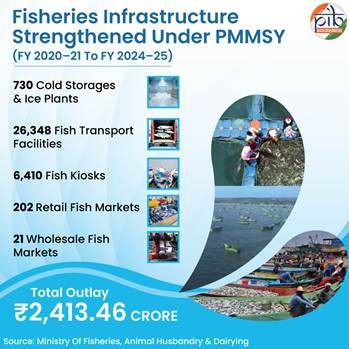
India’s fisheries expansion has been backed by sustained policy and institutional reforms. The Pradhan Mantri MatsyaSampada Yojana (PMMSY), with an outlay exceeding ?20,000 crore, has strengthened infrastructure through cold storages, transport facilities, fish kiosks, and landing centres, while also promoting fisher welfare, digital inclusion, and safety at sea. Complementary initiatives such as climate-resilient coastal fishermen villages, vessel tracking systems, and the Marine Fisheries Census 2025 aim to improve resilience, targeting, and governance.
Regulatory and scientific institutionssuch as ICAR fisheries institutes, the Marine Products Export Development Authority, and the National Fisheries Development Boardhave promoted innovation, best practices, and environmental compliance. FAO-supported projects, including climate-resilient aquaculture models in Andhra Pradesh and ecosystem-based fisheries management initiatives in the Bay of Bengal, further reinforce sustainability-oriented reforms.
Emerging Opportunities
India’s blue economy potential is expanding through deeper engagement with global seafood markets, improved traceability systems, and new rules for the sustainable harnessing of the Exclusive Economic Zone. Digital platforms for traceability and certification can help Indian exports meet stringent international standards, improving price realisation and reducing rejection risks. Women-centric interventions under PMMSY and allied schemes also open avenues for inclusive growth through processing, retail, and value-added activities.
Persistent Challenges
Despite rapid progress, structural challenges remain. Overfishing and juvenile catch continue to stress nearshore stocks, while habitat degradationthrough pollution, sedimentation, and seagrass lossundermines nursery grounds. Illegal, unreported and unregulated (IUU) fishing erodes sustainability and equity. Post-harvest losses remain high, and small-scale fishers often face limited access to credit, insurance, and modern technology. Climate change further amplifies risks through extreme weather, warming waters, and disease outbreaks in aquaculture.
Way Forward
The FAO’s call for renewed commitment emphasisesscience-based stock management, expansion of deep-sea fisheries to reduce coastal pressure, robust traceability and certification, and biosecure, climate-resilient aquaculture systems. Investing in resilient harbours, early warning systems, and ecosystem-based approaches will be critical to safeguard livelihoods and biodiversity.
Conclusion
India’s fisheries and aquaculture sector stands at a pivotal moment. Having achieved scale and global prominence, the next phase of India’s Blue Transformation must prioritise sustainability, value addition, and inclusivity. With coordinated policy action, scientific management, and strong institutional support, India can convert its fisheries momentum into a resilient, competitive, and environmentally responsible blue economy that secures livelihoods, nutrition, and long-term ecological balance.