Districts as Export Hubs
- 11 Sep 2026
In News:
The Government is strengthening the Districts as Export Hubs (DEH) Initiative to make India’s export growth more geographically broad-based and inclusive. The initiative seeks to transform each district into a unit of export planning by identifying locally produced goods and services with global potential and connecting producers with international markets.
India’s total exports of goods and services reached US$825.25 billion in 2024–25 and were estimated at US$863.11 billion in 2025–26, highlighting the need to expand the geographical base of export growth.
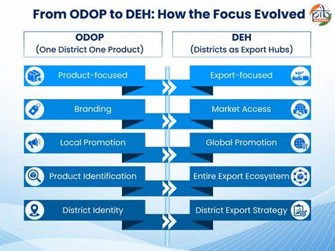
From ODOP to DEH
The DEH framework builds upon the One District One Product (ODOP) approach, which originated as a Uttar Pradesh initiative in 2018 and was subsequently expanded nationally.
While ODOP focuses primarily on identifying, branding and promoting a distinctive product from each district, DEH adopts a broader approach by developing the entire export ecosystem—production, quality standards, logistics, certification, market access and exporter capacity.
As of January 2026, DEH covered more than 770 districts across India.
Key Features of DEH
1. District-level export planning: Districts are treated as units of export planning rather than merely production centres. District-specific products may include GI-tagged goods, agricultural products, handicrafts, textiles, engineering goods and toys.
2. Convergence-based framework: DEH is not a separate funding scheme. It leverages existing Central and State government schemes and institutions to address district-specific export constraints.
3. Institutional architecture:
- Department of Commerce: Overall policy direction.
- DGFT: Implementation, coordination and monitoring.
- State Export Promotion Committees (SEPCs): State-level coordination.
- District Export Promotion Committees (DEPCs): Identification of export opportunities and resolution of local bottlenecks.
- District Export Action Plans (DEAPs): Map export potential, infrastructure gaps, logistics constraints and required interventions.
By March 2026, draft DEAPs had been prepared for 590 districts, of which 249 had been formally adopted.
Building Export Ecosystems
DEH seeks to improve:
- Quality and certification: Testing, packaging, branding and compliance with international standards.
- Digital exports: E-commerce platforms can help MSMEs access overseas consumers.
- Logistics: Dak Ghar Niryat Kendras provide postal export facilities for documentation, packaging and small consignments.
- Capacity building: Training in export procedures, logistics, packaging and regulatory compliance.
- Institutional support: DGFT has partnered with EXIM Bank under the Grassroots Initiatives for Development (GRID) programme in six districts—Anantapur, Raipur, Solan, Tiruppur, Kanpur and Kolhapur.
From 1 June 2026, a focused and outcome-oriented approach was adopted, initially covering districts across 27 States/UTs, supported by 24 DGFT Regional Authorities and 11 partner agencies.
Significance
DEH can help:
- Diversify India’s export base beyond established industrial clusters.
- Integrate MSMEs, artisans and farmers into global value chains.
- Generate employment and incomes at the grassroots.
- Promote GI products and local specialisations.
- Reduce regional disparities through export-led development.
- Advance Aatmanirbhar Bharat and Vocal for Local.
- Support India’s ambition of achieving US$1 trillion in exports.