
Ethanol Blending in India: E20, E85 and the Road Ahead
- 07 Jul 2026
In News:
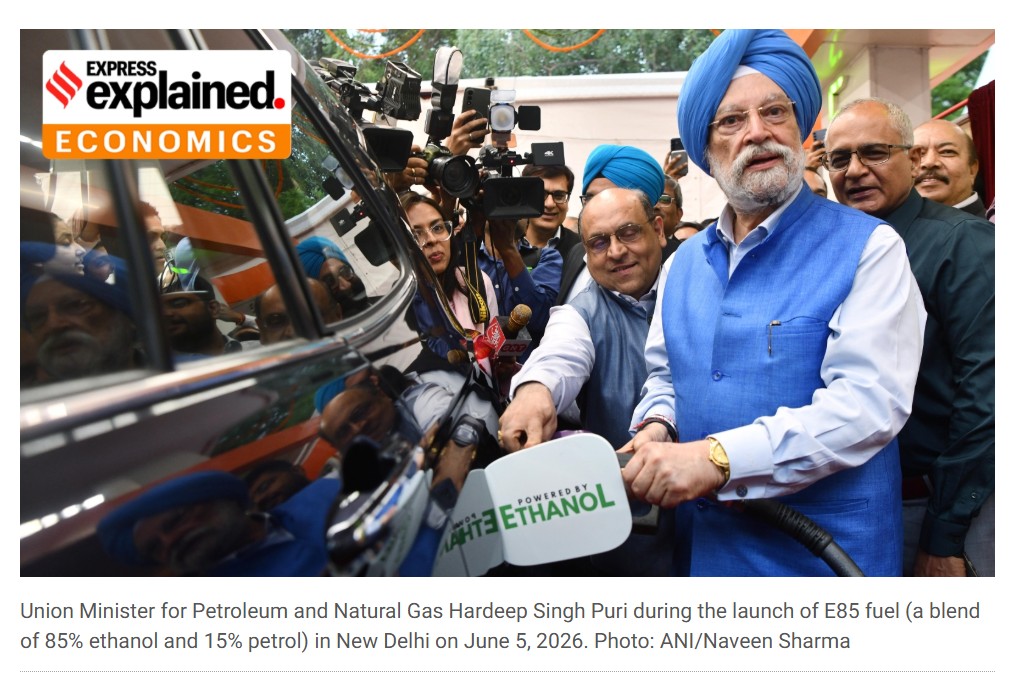
India has successfully achieved 20% ethanol blending (E20) in petrol, five years ahead of its original 2030 target. Building on this achievement, the Government recently launched E85 fuel (85% ethanol and 15% petrol) in New Delhi for flex-fuel vehicles, signalling the next phase of India's biofuel transition. However, concerns regarding mileage, engine compatibility and consumer choice have gained prominence.
Background: India's Ethanol Blending Journey
India launched the Ethanol Blending Programme (EBP) to reduce crude oil imports, improve energy security, support farmers and lower vehicular emissions.
The National Policy on Biofuels, 2009 had initially proposed 20% ethanol blending by 2017, but implementation remained slow due to limited production capacity and supply constraints. Subsequently, the National Policy on Biofuels, 2018 and its amendments accelerated ethanol production and blending. The government later advanced the target of 20% ethanol blending from 2030 to 2025-26, which has now been achieved ahead of schedule.
The blending level increased rapidly from E10 to E20 within about three years, requiring significant changes in fuel supply and automobile manufacturing.
What are E20 and E85?
- E20: Petrol containing 20% ethanol and 80% petrol.
- E85: Fuel containing 85% ethanol and 15% petrol, primarily intended for flex-fuel vehicles (FFVs) that are specifically designed to operate on higher ethanol blends.
Why is Ethanol Blended with Petrol?
The Government promotes ethanol blending to achieve multiple objectives:
- Reduce dependence on imported crude oil.
- Improve India's energy security.
- Lower greenhouse gas emissions.
- Enhance farmers' income by creating demand for sugarcane, maize and other feedstocks.
- Promote cleaner and renewable transportation fuels.
- Support India's commitments towards climate change mitigation.
Chemistry Behind Ethanol Blending
Ethanol (C?H?OH) has a shorter carbon chain than petrol hydrocarbons (generally C?–C??). Consequently, combustion of ethanol releases comparatively less carbon dioxide.
Another important property is its high Research Octane Number (RON) of around 108, which offers excellent anti-knock characteristics. Higher octane fuels permit engines to operate at higher compression ratios, potentially improving efficiency in engines specifically designed for ethanol blends.
However, ethanol possesses lower calorific value than petrol, meaning it contains less energy per litre. Therefore, vehicles not optimised for ethanol generally experience reduced fuel economy.
Advantages of Higher Ethanol Blending
Higher ethanol blending offers several economic and environmental benefits.
- Reduces India's crude oil import bill and improves energy security.
- Lowers vehicular carbon emissions compared to conventional petrol.
- Supports domestic agriculture through increased demand for ethanol feedstocks.
- Encourages development of the biofuel industry and rural employment.
- High octane rating improves combustion efficiency and reduces engine knocking.
- Can enable future engine designs with higher compression ratios and better performance.
Challenges Associated with Higher Ethanol Blends
Despite its advantages, higher ethanol blending presents several challenges.
1. Reduction in Fuel Economy: Ethanol contains less energy than petrol. Consequently, vehicles not specifically engineered for higher ethanol blends experience a noticeable decline in mileage.
As blending levels increase from E20 towards E25 or E85, the reduction in fuel efficiency becomes more significant.
2. Compatibility with Older Vehicles: Older vehicles designed for E10 fuel may face compatibility issues.
Ethanol is hygroscopic, meaning it readily absorbs moisture from the atmosphere. This can increase the risk of corrosion in fuel tanks, pipelines, rubber seals and other engine components.
Higher combustion temperatures may also affect engine performance, particularly during cold starts.
3. Lack of Consumer Choice: Unlike Brazil, Indian consumers currently have limited choice at fuel stations, with no option to select different ethanol blends based on price or vehicle compatibility.
Similarly, higher ethanol blends are not accompanied by significant price incentives despite reduced mileage.
4. Engineering Challenges: Further progression towards E25 would require:
- Recalibration of engines.
- Improved corrosion-resistant materials.
- Fuel system redesign.
- Fresh homologation and certification.
- Greater compatibility testing, especially for older vehicles and two-wheelers.
E85 and Flex-Fuel Vehicles
Flex-Fuel Vehicles (FFVs) are capable of operating on petrol, ethanol or varying blends of both.
The launch of E85 marks India's first step towards developing an FFV ecosystem.
However, despite E85 being expected to cost around ?20 per litre less than E20, its lower fuel efficiency currently limits its economic attractiveness. Until sufficient price incentives emerge, consumers may continue to prefer lower ethanol blends.
Brazil's Ethanol Model: Lessons for India
Brazil is regarded as the global leader in ethanol-based transportation.
Its ethanol programme began during the 1970s oil crisis, and over the past five decades it has developed a mature ethanol ecosystem.
Key features of the Brazilian model include:
- Petrol generally contains 27–35% ethanol.
- Consumers can choose between blended petrol and E100 (pure hydrous ethanol).
- Extensive adoption of flex-fuel vehicles.
- Strong government pricing support ensures ethanol remains economically competitive.
- Consumers switch fuels depending on prevailing market prices.
India can draw valuable lessons by gradually expanding consumer choice, strengthening flex-fuel infrastructure and adopting pricing mechanisms that encourage voluntary transition.
Significance for India
The expansion of ethanol blending is an important component of India's clean energy transition.
It contributes to:
- Energy security by reducing dependence on imported fossil fuels.
- Climate commitments through lower transport sector emissions.
- Doubling farmers' income by creating new markets for agricultural produce.
- Circular economy through utilisation of agricultural residues and biomass.
- Atmanirbhar Bharat by promoting indigenous fuel production.
Way Forward
India's ethanol programme has achieved remarkable progress, but future expansion beyond E20 should be accompanied by scientific validation, consumer awareness and adequate technological preparedness. Promoting flex-fuel vehicles, expanding feedstock diversification beyond sugarcane, improving second-generation ethanol production and providing consumers with greater fuel choice and transparent pricing will ensure a balanced and sustainable transition.